KHTS Radio Santa Clarita Radio – Santa Clarita News

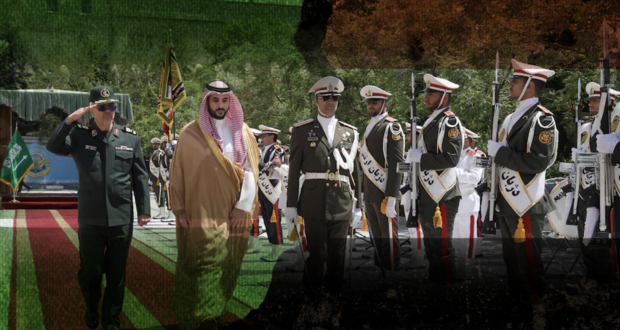
Military escalation between Yemen’s Houthi movement and Saudi Arabia is continuing. On Monday, Saudi Arabia said it had intercepted three drones over the Riyadh area and the south of the kingdom, without identifying their source, amid repeated attacks on the kingdom by Yemen’s Iran-backed Houthis.
Saudi Defence Minister Prince Khalid bin Salman arrived in Tehran on Monday to take part in talks, alongside Pakistan’s army chief Asim Munir, Turkish intelligence chief Ibrahim Kalin and other senior officials.
They travelled to Iran in an effort to “de-escalate tensions between the parties to the current crisis and encourage dialogue and diplomatic solutions”, according to a statement from the Saudi foreign ministry.
Iranian state television reported on Monday that those attending had agreed to “continue discussions with the aim of strengthening co-operation, including in the areas of regional peace and security”.
Mohsen Rezaei, secretary of Iran’s Supreme National Security Council, told state television on Monday after meeting senior officials from the three countries: “We had very good talks.” He added: “I feel a new atmosphere is taking shape in the region… I sensed a very positive atmosphere during the discussions between the officials.”
What is happening behind the scenes
Meanwhile, the Israeli newspaper Israel Hayom reported that the Saudi defense minister, Prince Khalid bin Salman, had travelled to Tehran to reach an Iranian-brokered deal with the Houthis, under which Riyadh would transfer $1bn (£750m) to the group via Iran.
One source said the money had been flown in on a military aircraft, although a Saudi official did not confirm any transfer of funds. The report comes amid Houthi attacks on Saudi oil facilities and Iranian efforts to expand Tehran’s regional influence.
Saudi Arabia has realized that defeating the Houthis militarily is impossible, even though it remains the biggest military spender in the Middle East, with defense spending reaching $83.2bn in 2025, an increase of 1.4% on the previous year.
The Houthis have declared Riyadh airport a military target, and during October have struck airports, ports and oil facilities with ballistic missiles and drones.
Flight-tracking data released on Monday showed that attacks by Yemen’s Iran-aligned Houthi movement have left the skies over Riyadh almost empty this month, with cancellations grounding nearly nine in every ten scheduled flights at the Saudi capital’s airport.
The latest figures from aviation analytics firm Cirium showed that about 86% of scheduled flights at Riyadh’s King Khalid International Airport – 4,071 out of 4,736 – were cancelled between 8 and 25 October, according to Reuters.
The attacks have led international airlines to suspend flights to the Saudi capital until November, while Delta Air Lines has postponed the launch of its Riyadh route until next year.
On Saturday, the International Automobile Federation (FIA) announced that the 2027 Dakar Rally Saudi Arabia, scheduled for 1-15 January, would not take place in the kingdom, citing recent developments in the region.
On Sunday, the Asian Football Confederation also postponed the match between Saudi club Al-Nassr and the UAE’s Al-Wasl, which had been due to be played in Riyadh on Monday as part of the third round of the unified group stage of the AFC Champions League Elite.
Saudi Arabia bows to Iran’s terms
Iran’s foreign ministry had previously said Tehran was ready to offer its “good offices” to help facilitate talks between Yemen and Saudi Arabia, amid questions over Tehran’s ability to reduce attacks on Saudi civilian facilities.
The Iranian foreign ministry quoted Foreign Minister Abbas Araghchi as saying that regional crises cannot be resolved militarily and that Tehran supports a political track. Observers, however, believe that undisclosed talks led Saudi Arabia to bow to Iran’s terms and send its defense minister to Tehran, along with the cost of a peace deal.
Iran has exploited the Houthi escalation to break its international isolation, while Saudi Arabia now finds itself negotiating peace with the very country that arms its current adversary, the Houthi movement, with drones and ballistic missiles.
Yemeni journalist Mona Safwan said: “Saudi Arabia has realiszd that it is losing militarily in Yemen, and that its allies are the weakest. They have been draining it and lying to it in order to plunder money, and it knows it cannot recover Bab al-Mandab by relying on them, their media fabrications and their political trickery.”
In a post on X, she added: “Because of the government in exile, Saudi Arabia lost Yemen and turned to Tehran.”
Meanwhile, observers say Iran has used the Houthi escalation against Saudi Arabia to break its international isolation, and is now hosting officials from several countries on the issue.
A crisis among allies
Saudi Arabia faces a difficult position. Turkish Defense Minister Yasar Guler has said his country does not plan to involve its armed forces in any direct confrontation with the Houthis in Yemen. Mr Guler explained that the joint defense agreement signed with Saudi Arabia and Pakistan does not necessarily mean entering into combat on the ground.
Pakistan, for its part, has ruled out direct military intervention in Yemen. According to observers, Pakistan – which carries the heavy memory of its involvement alongside the United States in the Afghan war against the Soviet Union – will be extremely wary of being drawn into a new war in Yemen, fearing the repercussions for its internal security, the economy of its western provinces and its sectarian balance.
Yemen has been left with a security vacuum since the UAE withdrew from the country at the beginning of this year. With the local forces trained by the UAE sidelined, the west coast, along with the Bab al-Mandab area, fell to the Houthis.
The UAE’s withdrawal removed a key element of the internal security landscape, opening the way for militant Islamist groups, including al-Qaeda in the Arabian Peninsula (AQAP), to regroup and take advantage of the weakened security control left behind.
The UAE had played a major role in securing and organisizg Yemen’s west coast – including Mocha, Bab al-Mandab and Hudaydah – by building, training and equipping local military factions, most notably the National Resistance and the Giants Brigades.