KHTS Radio Santa Clarita Radio – Santa Clarita News

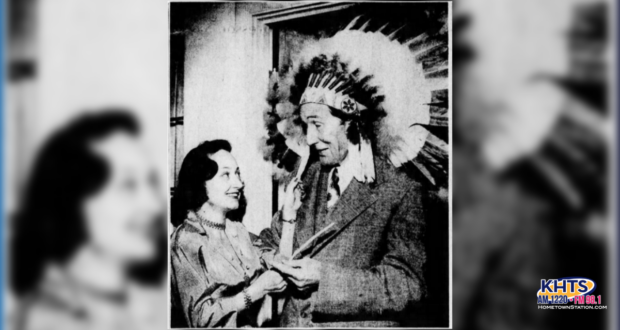
On January 10, 1981, Robert E. Callahan, author, historian, collector and showman, died at the age of 88, leaving behind Callahan’s Old West Trading Post on Sierra Highway.
Born in Virginia in 1892, Callahan developed a lifelong fascination with the American West and Native American history.
He claimed a mathematically dubious 1/6th Iroquois ancestry, spoke at least 14 Indigenous languages and spent much of his youth traveling, performing as a sharpshooter, and living among Native communities in the Southwest.
He also wrote about joining Buffalo Bill’s Wild West Show as a teenage sharpshooter, before being dismissed when his true age was discovered, and about later traveling by train and on foot through the Southwest to continue his cultural education among Native communities.
While these accounts were presented as personal history, they were also part of Callahan’s literary persona, showcased in his 1926 novel “Heart of an Indian,” and are likely a mix of fact, embellishment, and myth-making typical of early-20th-century Western writers.
Over time, his portfolio expanded to include Western novels, magazine stories, and books on Indigenous history, three of which were later adapted for film, including “Wife Wanted” (1946) “Daughter of the West” (1949) and “Blonde Ice” (1948)
Callahan was particularly inspired by Helen Hunt Jackson’s novel “Ramona,” which helped popularize Southern California’s romanticized image of the “Old West” by highlighting the struggles of a half-Spanish, half-indigenous woman, and drew tourists to locations associated with the story, including Rancho Camulos in the Santa Clara River Valley.
Determined to present that history, Callahan began collecting artifacts and developing immersive historical attractions that blended education, entertainment and architecture.
In the late 1920s, he unveiled his ambitious Ramona Village project in Culver City, a planned complex of theaters, museums, gardens and recreated pueblos designed to celebrate California’s Native, Spanish and pioneer heritage.
Though the project was scaled back by the Great Depression, Callahan later reopened the site as Mission Village Auto Court, a precursor to modern theme parks with themed lodging, decorative teepees and a collection of eclectic buildings, including the little red schoolhouse, the Ramona Chapel and a traditional kiva.
When construction of the I-10 Santa Monica Freeway forced Mission Village to close in 1962, Callahan relocated much of the site to 13660 Sierra Highway in what was then known as Outlaw Canyon (now part of Agua Dulce), where it became Callahan’s Old West Trading Post, also called Indian Village.
Opening in 1965, the attraction featured frontier cabins, Indigenous dwellings, a museum packed with artifacts, a relocated Ramona Chapel, a little red schoolhouse, a frontier fort, Boot Hill cemetery and live entertainment ranging from Indian dancers to Old West gunfights. The site also became a frequent filming location for movies and television.
Callahan funded the project himself, often stating that he was not motivated by profit but by preservation.
After Callahan’s death in 1981, his widow, Marion Callahan, continued to preserve his collection.
In 1987, she donated several key structures, including the Ramona Chapel and the Little Red Schoolhouse, to the Santa Clarita Valley Historical Society, ensuring they would have a permanent home at Heritage Junction in Newhall.
To see yesterday’s today in history, click HERE.
Sponsored Articles
KHTS FM 98.1 and AM 1220 is Santa Clarita’s only local radio station. KHTS mixes in a combination of news, traffic, sports, and features along with your favorite adult contemporary hits. Santa Clarita news and features are delivered throughout the day over our airwaves, on our website and through a variety of social media platforms. Our KHTS national award-winning daily news briefs are now read daily by 34,000+ residents. A vibrant member of the Santa Clarita community, the KHTS broadcast signal reaches all of the Santa Clarita Valley and parts of the high desert communities located in the Antelope Valley. The station streams its talk shows over the web, reaching a potentially worldwide audience. Follow @KHTSRadio on Facebook, Twitter, and Instagram.