KHTS Radio Santa Clarita Radio – Santa Clarita News

On this day in 1875, one of notorious outlaw Tiburcio Vásquez’s lieutenants, Clodoveo Chávez, met his end in Arizona.
Though Vásquez left his mark on the Santa Clarita Valley through his notorious crimes, he was only one of numerous robbers who plagued California in its Wild West days.
One such fellow criminal was Luis Clodoveo de la Trinidad Chávez, known for most of his life as Clodoveo Chávez. Born August 4, 1849, in San Juan Bautista, California, Chávez was described as a 6-foot, 200-pound bully by adulthood.
The Chávez and Vasquez families were acquainted in the neighborhood, and by 1872, Clodoveo was working as a vaquero and eager to associate with the older bandit. Vásquez sent him to San Francisco, where the young man bought a saddle, bridle and twin six-shooters. Within days, he was in Hollister, east of San Juan, ready to ride with Vásquez.
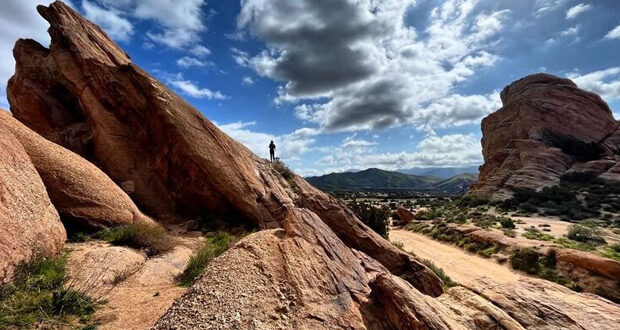
After several years of robberies and various crimes across California, Vásquez — the namesake of Vasquez Rocks near the Santa Clarita Valley — was captured on May 14, 1874, at a ranch house in present-day West Hollywood, following a lengthy manhunt by Sheriff William Rowland and a posse of armed men.
The Californio bandido had been pursued for a string of violent robberies and killings across the state. The posse, led by Rowland, acted on intelligence that Vásquez was hiding at “Greek George” Caralambo’s adobe in Rancho La Brea, near the modern intersection of Santa Monica Boulevard and Kings End Road in West Hollywood.
Chávez was not at the ranch when Vásquez was taken and likely disappeared into the nearby San Gabriel Mountains.
In late May 1874, Vásquez was transported by steamship to San Francisco. He eventually stood trial in San Jose for his various crimes, including one count of murder in the Tres Pinos robbery, the crime that made Vasquez a national name.
Vásquez admitted he was an outlaw but denied ever killing anyone. A note purportedly written by Clodoveo Chávez, one of his gang members, was dropped into a Wells Fargo box. Chávez wrote that he — not Vásquez — had shot the men at Tres Pinos.
Chávez eventually made his way down to Baja California, where he crossed the Colorado River into Arizona Territory. He took on his mother’s maiden name and went by José Espinosa.
In September 1875, Chávez was hired on at the ranch of N.G. Baker on the Gila River, near present-day Tacna. He might have remained undetected except for an extraordinary coincidence.
Luis Raggio, a man a few years younger who had grown up in San Juan Bautista with Chávez, arrived in Arizona Territory with his 15-year-old brother, Vicente, around the same time.
After taking a cattle-driving trip that Raggio feared would be too long and hard for his younger brother, he left Vicente behind. On his return, Raggio learned that Vicente had met another man from California and that the two had gone to Baker’s ranch on the Gila. Raggio was surprised, as he and his brother knew no one in Arizona Territory.
Raggio headed for the Baker ranch, and as he later recalled: “When I rode up to the bunkhouse, I heard a familiar voice, and the first person I met was Chávez. He told me that he had taken a bunch of stolen horses into Mexico, but that he had met better horse thieves down there than he was and had lost all of them. He said that he was going back to San Juan in a few months and kill Judge [David] Belden, who had sentenced Vásquez to be hung, and several other persons who had given testimony against them. I listened to all of this without saying very much, as the last time I had seen Chávez, he and his gang had thrown rocks at me, and I had roped and dragged him.”
When Chávez warned him to keep quiet, explained Raggio, “I…told him that I had no intention of giving him away, and that if he would let me alone, I would let him alone.”
Raggio, however, promptly wrote a letter to Judge Breen in San Juan, asking if Chávez was still wanted.
Two weeks later, after rounding up Woolsey’s cattle, Raggio returned to find Vicente suspected of stealing money, revolvers, and ammunition from Baker. Raggio recalled: “Someone told me that the boy was at Chávez’s cabin. I rode over to the cabin and came upon both of them seated under the tree on a blanket. Chávez had taken apart one of the stolen pistols and was cleaning and oiling it. It immediately occurred to me that Chávez was at the bottom of all of this… I quickly made up my mind not to let Chávez suspicion this. I gave the boy a hard scolding and made him roll the parts of the pistol up in a handkerchief and come with me. I told him that I would whip him if I ever heard of him doing such a thing again.”
A few days later, a letter arrived from Breen advising that Chávez was indeed wanted.
Raggio approached Baker, who agreed to help capture the fugitive. He assigned two of his best men, Clark Colvig and Harry Roberts, to assist. Raggio insisted they take Chávez alive. The outlaw was digging a trench for a palisade-like wall around the ranch buildings. The plan was for Raggio to seize the muscular outlaw from behind while the others bound him with fence wire.
But when Colvig and Roberts rode up, Colvig, carrying a Colt Model 1855 revolving shotgun, ignored the plan. He ordered, “Throw up your hands!”
“Chávez did not even look at him,” recalled Raggio. “He jumped sideways out of the ditch and started to run for his cabin… Colvig fired… and hit him in the back just below the shoulders with a charge of buckshot… I lifted up his head just as he made his last gasp.”
Clodoveo Chávez, 26, died on November 25, 1875.
Chávez was decapitated and his head preserved in a pickle jar of alcohol. After an inquest in Yuma County to establish identification and clear wrongdoing, his severed head was transported to Los Angeles to claim the $2,000 reward.
Chávez’s pickled head is believed to have been destroyed along with the rest of Dr. Louis Jordan’s “freak museum” in the 1906 San Francisco Earthquake and subsequent fire.
To view yesterday’s Today in History, click here.
Ed. Note: Quotes sourced from John Boessenecker’s “Bring Me the Head of Clodoveo Chávez.”
Sponsored Articles
KHTS FM 98.1 and AM 1220 is Santa Clarita’s only local radio station. KHTS mixes in a combination of news, traffic, sports, and features along with your favorite adult contemporary hits. Santa Clarita news and features are delivered throughout the day over our airwaves, on our website and through a variety of social media platforms. Our KHTS national award-winning daily news briefs are now read daily by 34,000+ residents. A vibrant member of the Santa Clarita community, the KHTS broadcast signal reaches all of the Santa Clarita Valley and parts of the high desert communities located in the Antelope Valley. The station streams its talk shows over the web, reaching a potentially worldwide audience. Follow @KHTSRadio on Facebook, Twitter, and Instagram.