KHTS Radio Santa Clarita Radio – Santa Clarita News

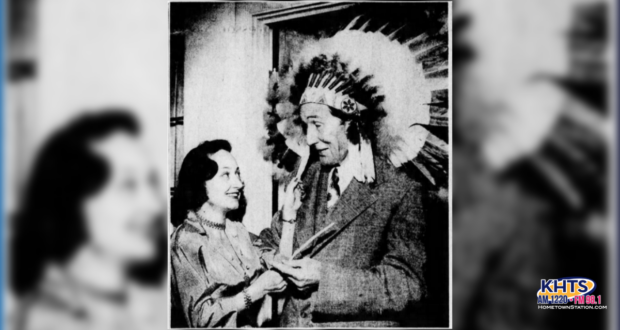
Robert E. Callahan, the man behind the former Callahan’s Old West attraction along Sierra Highway in Mint Canyon, was born on Oct. 27, 1892, in Virginia.
Over the course of his life, Callahan built a reputation as an author, businessman and collector of Native American and Western artifacts, eventually bringing his vision of the Old West to the Santa Clarita Valley.
Callahan’s story was shaped in part by the popularity of Ramona, a novel published in 1884 by Helen Hunt Jackson. The book helped fuel interest in Southern California’s Spanish and Native American history, drawing visitors to locations associated with its story, including Rancho Camulos in the Santa Clara River Valley.
Jackson originally intended Ramona to draw attention to the mistreatment of Native Americans in California. Her earlier nonfiction book, A Century of Dishonor, published in 1881, documented injustices against Native Americans and sought to encourage changes in government policy.
However, the novel’s romantic storyline and descriptions of Southern California ultimately became more prominent in the public imagination than its social message.
The popularity of “Ramona” sparked a tourism boom, and Callahan became one of the many people captivated by the story. That fascination eventually inspired several of his most ambitious projects.
A Life Shaped By The American West
Callahan had Native American ancestry, with one-sixth Iroquois heritage, and developed a deep interest in Indigenous cultures and Western history. He reportedly spoke 14 Native American dialects and spent much of his life collecting artifacts associated with Native American communities and the American frontier.
His adventures began early. At 13, Callahan joined Buffalo Bill’s Wild West Show, where he demonstrated his rifle and shotgun skills. His time with the show ended after organizers discovered he had misrepresented his age.
Callahan subsequently traveled by train to New Mexico, where he spent two years living among Native American communities. He later moved to Los Angeles, appeared in a silent film and traveled to Chicago to study advertising.
His advertising career developed into a successful retail enterprise that eventually allowed him to retire to California during the 1920s. He also published a book about advertising and sales, produced radio programs for Warner Bros. in Hollywood and wrote Western stories for the Los Angeles Times Sunday Magazine.
Callahan authored several books, including “Heart of an Indian,” “The Lone Indian,” “Santa Fe Trail” and “Daughter of Ramona”. He claimed “The Lone Indian” helped inspire the Lone Ranger, and three of his 10 books were adapted into films.
His connection to “Ramona” extended beyond his writing. Callahan created the original Ramona Pageant, an outdoor theatrical production that continues to be performed in Hemet.
However, his most recognizable legacy would come from his efforts to bring the history and atmosphere of the American West to life through physical attractions.
From Ramona Village To Mission Village
In 1928, Callahan announced plans for Ramona Village, an ambitious attraction planned for a three-and-a-half-acre site at 5675 Washington Boulevard in Culver City.
According to a June 10, 1928, report in the Los Angeles Times, the proposed development was dedicated to Native American traditions and welfare and was expected to cost approximately $500,000.
The plans called for a theater seating 2,000 people, a trading post, a museum, a Spanish café, an amphitheater, an Indian village, gardens and recreations of Southern California landscapes. Callahan envisioned a destination featuring performances, traditional crafts, music and cultural demonstrations.
The architectural firm Meyer & Holler, known for its work on Hollywood’s Egyptian and Chinese theaters, was selected to design the complex.
A central attraction was supposed to be an Indian theater featuring Native American performers in a dramatization of “Ramona.” The grounds would also include workshops for Native American artists and craftspeople, along with spaces for dances and ceremonies.
Construction began in 1928, and the first building was completed that July. Later plans included a small chapel modeled after the chapel at Rancho Camulos. Callahan reportedly built it in memory of his first wife, Essie.
The stock market crash of 1929, however, undermined Callahan’s finances and prevented him from completing the original project.
Rather than abandon the idea altogether, Callahan secured new financial backing from two local merchants. In June 1932, he announced plans for Mission Village on the same Culver City property.
The revised development included Spanish-style buildings, Native American pueblos, a trading post, a museum and accommodations for motorists. It formally opened on July 23, 1932.
A contemporary account published in the Los Angeles Times described a trading post built with weathered beams and railroad cross ties, along with a museum containing artifacts connected to Western history. The property also displayed artwork and objects associated with the story of “Ramona” and the region’s early ranching days.
Among the items reportedly displayed were branding irons from the Pio Pico Ranch, rifles associated with the Battle of the Little Bighorn and wine casks from the Del Valle Ranch above Newhall.
The property also included a collection of Spanish-style bungalows equipped for housekeeping, making it an early example of a motorist-oriented lodging destination.
Mission Village remained in operation for roughly three decades, but another major obstacle eventually forced Callahan to relocate.
A New Home In Mint Canyon
In 1962, plans for the Santa Monica Freeway threatened the Mission Village property. Callahan initially considered moving the attraction to North Hollywood, but zoning difficulties prevented that plan from moving forward.
He ultimately purchased a 14-acre property at 13660 Sierra Highway in Mint Canyon, where he established a new attraction known as Indian-Frontier Village. The destination later became widely known as Callahan’s Old West.
The new site featured replicas of Native American dwellings, frontier cabins, a small Western fort, spirit poles and other structures intended to evoke life in the American West.
Callahan also transferred portions of his extensive artifact collection to the property. The collection reportedly included thousands of horseshoes, hundreds of wagon wheels and cowbells, and a large painting depicting the historic Santa Fe Trail.
Other attractions included a gold mine, a Boot Hill cemetery, a small red schoolhouse, a replica of a cabin associated with outlaw Emmett Dalton and the Ramona Chapel, which Callahan had moved from Mission Village.
The site also featured a museum, a collection of firearms, miners’ cabins, a gold camp rolling store and the Outlaw Saloon.
Indian-Frontier Village opened to the public on May 15, 1965, following approximately two years of construction. An official opening ceremony was held later that month.
On weekends, visitors could watch Native American dancers, Western gunslingers and vaudeville performers. The attraction also served as a filming location for movies and television programs, making use of its collection of historic-looking buildings and frontier settings.
Callahan hoped the property would eventually become a public resource. He said he intended to reinvest any profits into additional attractions and artifacts and expressed a desire to transfer the project to a government agency for public use.
That goal never came to fruition.
Callahan’s Lasting SCV Legacy
Callahan’s later years were marked by health problems. According to contemporary reporting, he was struck by a train shortly after the village opened in 1965. Although he survived, the accident contributed to a period of declining health.
In August 1973, Callahan put the property up for sale. Despite having spent approximately $160,000 developing the attraction, he listed it for $125,000. By then, the village was open only on Sundays, and Callahan and his wife, Marion, had retired to their home in Toluca Lake.
Callahan died on Jan. 10, 1981, at age 88. His death did not immediately end the property’s connection to the entertainment industry. Marion retained ownership and rented the village for filming and other uses, including performances by the Canyon Theatre Guild before the theater company moved to Old Town Newhall.
Marion later donated several artifacts and buildings from Callahan’s Old West to the Santa Clarita Valley Historical Society. The donations included the Ramona Chapel and the little red schoolhouse, both of which can be found at Heritage Junction Historic Park in Newhall.
Although the attraction no longer operates as it once did, remnants of Callahan’s Old West remain along Sierra Highway in Mint Canyon.
Callahan’s life connected the popularity of a 19th-century novel with the development of a distinctive roadside attraction in the Santa Clarita Valley. Through his writing, collecting and ambitious historical recreations, he sought to preserve and present stories of Native American cultures and the American frontier.
Today, the surviving structures and artifacts offer a reminder of the man who brought his vision of the Old West to Mint Canyon.
To read yesterday’s Today in History, click here.
Sponsored Articles
KHTS FM 98.1 and AM 1220 is Santa Clarita’s only local radio station. KHTS mixes in a combination of news, traffic, sports, and features along with your favorite adult contemporary hits. Santa Clarita news and features are delivered throughout the day over our airwaves, on our website and through a variety of social media platforms. Our KHTS national award-winning daily news briefs are now read daily by 34,000+ residents. A vibrant member of the Santa Clarita community, the KHTS broadcast signal reaches all of the Santa Clarita Valley and parts of the high desert communities located in the Antelope Valley. The station streams its talk shows over the web, reaching a potentially worldwide audience. Follow @KHTSRadio on Facebook, Twitter, and Instagram.