 KHTS Radio Santa Clarita Radio – Santa Clarita News

Santa Clarita and the rest of Southern California may be facing another drought less than a year after officials declared the last one over.
Sponsored Articles
From Oct. 1 through the middle of February, Southern California has only received 25 to 35 percent of its expected rainfall, according to the National Weather Service.
“The three wettest months for California are typically January, February and March,” said Jayme Laber, Senior hydrologist with the National Weather Service. “And those months are almost over.”
Last year, Northern and central California received a substantial amount of rain, but the water quickly dried up for Southern California.
“Northern California received so much rain rivers were flooding and dams were almost breaking,” said Laber. “Southern California did receive a fair amount of rain, but not as much as we needed to fully restore our local reservoirs.”
However, one of the greatest benefits to the SCV last year were the “Drought Buster” storms that have hit the northern parts of the state, which the SCV imports roughly half of its water from, said Dirk Marks, SCV water, Water Resource Manager.
Before last years rainfall, much of the water Santa Clarita imported from northern regions of the state were limited.
At one point in 2013 SCV Water could only import 5 percent of the contracted amount of water from up north. However, once the northern part of the state received a large amount of rainfall that figure increased to 60 percent of the contracted amount, said Marks.
Related: Santa Clarita Asked To Pay For Drought Valencia Water Company Proposes Rate Hike
Every week, a drought monitoring map is released to show the drought across various areas of the state, said Laber.
“Currently, Los Angeles County and Ventura County are in the lowest level of drought, which is moderate,” said Laber. “Two weeks ago, Santa Barbara County was moved to the second level of drought, which is considered severe.”
In non-drought years, the lower parts of California receives 12 to 16 inches for rainfall — a far cry from the two or three inches that have fallen since 2018 began, Laber said.
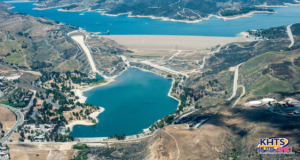
“Lake Cachuma Reservoir, which is responsible for feeding water to the Santa Barbara area is only at 39 percent capacity, and Lake Casitas, which feeds water to Ventura County, is only at 35 percent capacity,” said Laber.
During the last drought Santa Clarita residents were using noticeably less water, and as a result residents were being charged more for water.
“SCV water agency, like any water agency, requires a minimum level of revenue to operate and maintain its system,” said SCV Water Co. General Manager Ken Petersen. “Unfortunately, when water sales decline by 20 percent because of extended and state-mandated conservation, we must adjust our rates to ensure we have sufficient revenue to maintain a reliable and high-quality water delivery system.”
In years past, during a drought Santa Clarita residents were given strict water restrictions.
Residents were prohibited from hosing down driveways and sidewalks, and were not able to use their decorative water fountains.
Residents were also only able to wash their cars if the hose was fitted with a nozzle that would stop the flow of water when the hose was not being used.
If residents did not follow the specific water restrictions laid out in the Water Action Plan, they would be issued two written warnings..
“A fine of $50 per day for the first infraction and increase by $50 for each additional infraction up to the maximum $500 per day,” after the third notice.
No significant rain is in the forecast for Santa Clarita, Laber said.
“There is a small chance to see drizzles Monday, and maybe more rain in the later part of next week, but it is to far in advance to know for sure,” he said.
Do you have a news tip? Call us at (661) 298-1220, or drop us a line at [email protected].Did you spot a correction? Let us know by emailing [email protected]
KHTS FM 98.1 and AM 1220 is Santa Clarita’s only local radio station. KHTS mixes in a combination of news, traffic, sports, and features along with your favorite adult contemporary hits. Santa Clarita news and features are delivered throughout the day over our airwaves, on our website and through a variety of social media platforms. Our KHTS national award-winning daily news briefs are now read daily by 34,000+ residents. A vibrant member of the Santa Clarita community, the KHTS broadcast signal reaches all of the Santa Clarita Valley and parts of the high desert communities located in the Antelope Valley. The station streams its talk shows over the web, reaching a potentially worldwide audience. Follow @KHTSRadio on Facebook, Twitter, and Instagram, and sign up for KHTS email and text alerts today!




So we can send a Tesla Sports Car into space but for some reason can’t get our Government onboard with converting sea water into drinking water. Why is it??
And for some ridiculous reason, houses continue to be built to bring thousands more to our city. Why? Where will we get the water from?
And what about the proposal to locate Amzon here? How will that affect our water supply? You just watch – Newhall Ranch and Amazon will get priority over existing users. While our trees die, they will be building more and more instead of admitting we are beyond our capacity.