KHTS Radio Santa Clarita Radio – Santa Clarita News

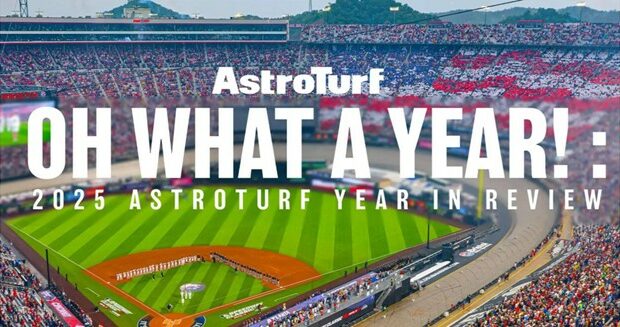
The synthetic turf industry’s founding company has released a comprehensive retrospective documenting what leadership describes as one of the most significant years in its six-decade history. AstroTurf unveiled its 2025 Year in Review digital magazine, titled “Oh What a Year!”, offering an interactive look at the partnerships, product launches, and installations that shaped the company’s performance throughout the calendar year.
The publication arrives on the heels of several high-profile announcements, including an official partnership with Major League Baseball and the commercial launch of a new bio-based turf system. These developments represent a convergence of heritage and innovation for the Dalton, Georgia-based manufacturer, which invented synthetic playing surfaces in the 1960s and continues to invest heavily in research and sustainability initiatives.
Major League Baseball Partnership Marks Historic Return
The centerpiece of the 2025 retrospective is AstroTurf’s designation as the Official Synthetic Turf of MLB. This partnership reconnects the company with professional baseball decades after its original surfaces transformed the sport’s relationship with playing fields. The agreement positions the manufacturer as the preferred synthetic surface provider for the league, a distinction that carries significant weight given baseball’s complex history with artificial turf.
The relationship between synthetic surfaces and professional baseball stretches back to March 1966, when the Houston Astros hosted the Los Angeles Dodgers in the first Major League game played on artificial turf. That installation solved a practical problem at the Astrodome, where natural grass could not survive beneath the domed roof. The innovation spread throughout the league during the 1970s and 1980s, with synthetic surfaces appearing in stadiums from coast to coast.
Contemporary baseball applications differ substantially from those earlier installations. The company’s Diamond Series technology, introduced in 2008, represents the first sport-specific turf system engineered exclusively for baseball. The surface incorporates customizable components for different field areas, with specialized fibers and differentiated pile heights creating surfaces that replicate the playing characteristics of both clay base paths and natural grass outfields. Nylon fibers in high-traffic zones provide realistic sliding distances while maintaining durability under intensive use.
The collegiate market has embraced these advanced baseball surfaces with particular enthusiasm. More Division 1 college baseball programs have chosen the Diamond Series than any other artificial turf system since 2009, according to company data. Universities, including Vanderbilt, Michigan, Kentucky, and Ohio State, have invested in installations that allow consistent practice schedules regardless of weather conditions.
Sustainable Technology Gains Traction
The second major announcement featured in the year-end publication is the commercial success of the RootZone GT-B USDA BioPreferred system. This product line incorporates sustainable materials while maintaining the performance characteristics that define the company’s turf technology. The system earned USDA BioPreferred certification, making AstroTurf the only synthetic turf manufacturer to achieve this designation.
The bio-based approach represents a significant shift in materials science for the synthetic turf industry. Traditional manufacturing relies heavily on petroleum-based plastics, contributing to carbon emissions throughout the production process. The company’s sustainable alternatives utilize agricultural by-products, including materials derived from sugar cane processing. Brazilian sugar cane provides raw material for organic polyethylene through a process that captures atmospheric carbon during plant growth cycles.
Environmental impact measurements demonstrate substantial improvements over conventional synthetic turf. Each standard hockey pitch using the company’s carbon-neutral technology saves approximately 73 tonnes of CO2 compared to traditional installations. Independent certification from Berlin-based consulting firm GUTcert validates these carbon-neutral claims through comprehensive lifecycle assessments.
Water conservation features prominently in the sustainability story. Proprietary surface technologies reduce friction between balls and playing surfaces, allowing certain installations to meet international federation standards for dry play. This advancement proves particularly valuable in regions facing water scarcity, where maintaining traditional irrigated surfaces presents significant challenges.
Nationwide Installation Program Expands Footprint
The digital magazine documents hundreds of new installations completed throughout 2025, spanning professional venues, collegiate facilities, high school fields, and community recreation spaces. This geographic expansion reflects growing adoption across market segments that historically favored natural grass.
Championship football stadiums and soccer venues account for a significant portion of the installation portfolio. However, the company emphasizes community-level projects as equally important to its mission. Youth sports facilities, municipal parks, and school athletic fields represent opportunities to bring advanced surface technology to athletes at all competition levels.
“2025 was a landmark year for AstroTurf,” said Gary Jones, the company’s Director of Marketing, in a press release accompanying the digital magazine release. “From our partnership with Major League Baseball to the success of our USDA BioPreferred RootZone GT-B system, our team pushed the boundaries of innovation while delivering excellence to hundreds of customers across the country.”
The installation volume reflects broader trends in sports facility management. Organizations increasingly recognize the advantages that extend beyond simple durability when evaluating surface options. Synthetic fields accommodate over 3,000 hours of annual use without degradation, compared to approximately 200-300 hours for natural grass before requiring renovation. This utilization capacity enables expanded programming and facility rental opportunities that support grassroots participation growth.
Research Partnerships Drive Technical Advancement
Behind the product launches and installations documented in the year-end review lies extensive research and development investment. The company maintains long-term partnerships with academic institutions, most notably the University of Tennessee’s Center for Athletic Field Safety. This collaboration, spanning more than twelve years, provides scientific validation for innovations in fiber technology, infill systems, and surface design.
Dr. John Sorochan and the university’s Department of Turf Sciences have contributed peer-reviewed research that grounds product development in biomechanical evidence rather than marketing claims. Studies examine how surface characteristics affect athlete movement, impact absorption, and injury patterns. The research acknowledges that multiple factors contribute to athletic injuries, including player conditioning, footwear selection, weather conditions, and individual biomechanics. Surface consistency addresses just one variable in this complex equation.
The company’s RootZone technology emerged from this research-driven approach. The system employs crimped nylon fibers that create a three-dimensional matrix beneath playing surfaces, effectively encapsulating infill material. Independent research from Michigan State University identified this design as producing favorable biomechanical characteristics among synthetic turf systems tested. The matrix minimizes infill migration during intensive play, ensuring that impact absorption remains consistent across the entire field surfaces throughout its operational lifespan.
Manufacturing facilities employ advanced testing equipment to validate product performance before field deployment. Berlin Athletes machines, QUV weathering testers, and accelerated wear simulators subject materials to conditions simulating decades of use within compressed timeframes. This in-house testing capability allows rapid prototyping and ensures innovations translate to real-world performance improvements.
Entertainment Venues Showcase Surface Versatility
The 2025 review period included several high-profile installations that demonstrated synthetic surface capabilities in unconventional settings. The Speedway Classic at Bristol Motor Speedway transformed NASCAR’s iconic venue into a temporary baseball stadium, with a Diamond Series field installed specifically for the exhibition game between the Atlanta Braves and Cincinnati Reds.
This ambitious project built upon experience gained from the 2016 Battle at Bristol football game, which attracted 156,000 spectators. The technical challenges of creating a professional-grade baseball diamond within a racing facility showcased the adaptability of contemporary synthetic turf systems. Following the event, the playing surface was donated to East Tennessee State University, extending the installation’s impact beyond the single showcase game.
The partnership with the Savannah Bananas represents another unconventional application featured during the review period. The world-famous entertainment baseball team received a new synthetic surface at Historic Grayson Stadium that supports both athletic performance and theatrical entertainment. The consistent playing characteristics enable elaborate sliding catches, acrobatic plays, and choreographed performances that push traditional field boundaries.
Industry Position and Competitive Landscape
AstroTurf occupies a unique position within the synthetic turf market as both the industry originator and a current technology leader. The company invented synthetic playing surfaces in the 1960s and has since accumulated institutional knowledge through installations at twelve World Series, eleven Super Bowls, ten Olympic Games, and thirty-five NFL Pro Bowls.
This heritage provides competitive advantages in research depth and application experience. The company controls all aspects of manufacturing and installation processes, from initial masterbatch formulation through final field construction. Vertical integration ensures quality control at every production stage, a consideration that has gained importance given recent industry discussions about material composition and chemical additives.
The sustainability credentials developed over recent years further differentiate the company’s market position. Membership in the Green Sports Alliance and early adoption of environmentally conscious production processes reflect proactive environmental stewardship. The establishment of turf recycling partnerships advances circular economy principles within sports infrastructure, addressing end-of-life considerations that have historically challenged the industry.
The “Oh What a Year!” digital magazine serves as both historical documentation and a forward-looking statement. The interactive format allows readers to explore feature stories, customer highlights, and event recaps through a visually compelling presentation. Project photography and behind-the-scenes content provide perspectives rarely available in corporate communications.
For organizations evaluating synthetic surface options, the publication offers insight into what comprehensive turf programs can deliver. The breadth of installations documented demonstrates versatility across sport types, competition levels, and geographic conditions. The technical achievements in sustainability and performance characteristics suggest continued innovation from a company that created an industry six decades ago and shows no signs of ceding its leadership position.