KHTS Radio Santa Clarita Radio – Santa Clarita News

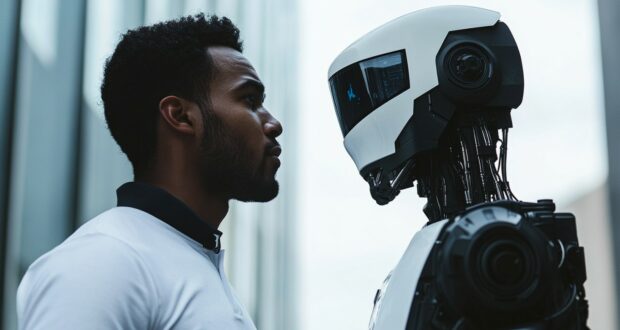
The wedding of robotics and artificial intelligence (AI) is transforming our lives, working life, and our way of seeing our world. Whether it’s AI-driven robots helping us at home and the healthcare sector or others being implemented in industry and space, they are transforming our business game and daily life. They are not only making us quicker and more accurate but also presenting us with new innovation and imagination avenues.
This article by Kirill Yurovskiy is on AI in robotics, business prospects and challenges it holds, and the Robotics-AI crossroad. Technocrat, experts, or avid viewers, with an awareness of AI-robotics crossroads has the solution to an awareness of the age of automation and the future.
- Robotics in Household Automation and Smart Assistants
AI robots are also transforming homes to provide them with more illumination and better space. AI robots like Roomba employ AI to move around and clean up the floors on their own, whereas Amazon Alexa and Google Home smart speakers utilize AI to switch lights off and on, adjust temperatures, and manage security systems.
The devices discover usage patterns, habits, and necessities in attempting to provide a personalized experience. With daily routines and rituals understanding, AI robotics is being directed towards an understanding of quality of life and convenience.
- AI-Controlled Drone Delivery and Surveillance
AI-controlled drones are transforming the logistics, agriculture, and security industries. Amazon and UPS are testing AI-controlled drones to get products delivered progressively faster.
The drones track plant health, watering, and pests to achieve optimal yields and efficiency in resources used in agriculture. AI offers real-time object detection and tracking to surveillance drones, to which they are of priceless value in security and disaster response.
- Medical Robotics: AI in Prosthetics and Surgery
Artificial intelligence is revolutionizing medicine by using robotics, for example, in surgery and prosthetics. Neural signals interpreted by AI are used by next-generation technology prosthetic arms such that it is simple for the patient to make complex movements.
In surgery, robots like the da Vinci Surgical System facilitate less-invasive and more accurate surgeries. AI-based robotic systems assist surgeons in medical image analysis, complication prediction, and even performing independent procedures. These are improving patient outcomes and making high-quality care accessible to more patients.
- AI in Industrial Robotics: Precision and Efficiency
AI has also evolved factory robots such that the machines have the capacity to do things faster and better than their former versions. AI robots can learn how to execute dynamic situations, optimize with time, and even work together with human laborers.
In manufacturing, for example, machine learning and computer vision-equipped robots are used to detect defects in products, put together piece parts and reassemble them, and guard assembly lines. Through the elimination of hazardous and repetitive tasks, AI-powered robotics is improving productivity and working conditions.
- The Emergence of Humanoid Robots
AI is helping in developing humanoid robots that can operate and look just like human beings. Robots such as Boston Dynamics’ Atlas and SoftBank’s Pepper walk, speak and behave like human beings to human beings.
The robots are being applied in customer care, education, and medicine as a companion and support role as well. With the new shape that will be experienced with humanoid robots, AI will be more efficient and more human-centric.
- Robotic AI for Space Exploration
Robotic AI is designed to be used by space exploration because spacecraft can move around in space and between planets. NASA rovers that travel to Mars, for instance, use AI in navigation on the ground, experimenting with samples, and feeding the results to Earth.
AI also enables real-time decision and processing of satellites under autonomous command. AI robots will be significantly involved in solving problems in deep space missions because space missions become increasingly complex.
- Ethical Impacts of AI-Based Robotics
The technological pace in AI-based robotics is not devoid of its own ethical issues such as job loss, privacy, and security. With increased robot autonomy, decision-making and accountability are at stake.
For example, suppose a robot injured an artificially intelligent person. Whom are we to hold accountable? How are we to hold robots accountable so that we do not discriminate against them unjustly and unethically? Those are issues that we need to address through discourse among policymakers, technologists, and ethicists to obtain rules and legislation.
- Case Studies: Leaders in AI Robotics Innovation
There are leaders in AI robotics development:
- Boston Dynamics: For creating its sophisticated humanoid and quadruped robots like Atlas and Spot.
- Intuitive Surgical: For creating AI-based surgery robots like the da Vinci system.
- DJI: Pioneers of AI-powered drones for photography, farming, and security.
The case studies that follow provide one example of the disruptive business change brought about by AI robotics.
- AI in Robotics in the Future: Beyond Automation
The future of robots isn’t automation, but creativity, collaboration, and adaptability. Robots will be doing more and more in partnership with humans, complementing us and driving innovation in new and diverse ways.
For example, the artificial intelligence of the robot can be utilized to support the development of art, producing new items, or discovering new frontiers. While artificial intelligence arises, man and machine’s coexistence era is limitless and extends to the era when robots come into being.
- The AI-Robotics Symbiosis in Daily Life
The complementary union of robotics and artificial intelligence is changing life and business every day and releasing creativity, innovation, and productivity potential the world has ever seen. Artificially intelligent robots, from home automation to medical care robots, factory floor robots, and even space discovery robots, are changing life and our way of work.
But to develop AI robots, we must overcome the ethical issues, provide equal opportunities, and put in place human-machine integration. To seek such harmony, we can have a future where AI robots will enrich our lives and society.
Final Words
The era of AI robots has finally dawned and is transforming the world in ways we could not even have conceived. From smart homes and drones to operating room robots and so much more beyond the confines of outer space, AI robotics is opening new doors and finding age-old answers.
As we move forward with this revolution, let us make sure that innovation and responsibility go together, so that AI robotics is an enabler, not a disabler. Let us harness the power of collective AI and robotics and usher in a new, innovative era. The era of AI robotics has begun—let us reap the benefits.