KHTS Radio Santa Clarita Radio – Santa Clarita News

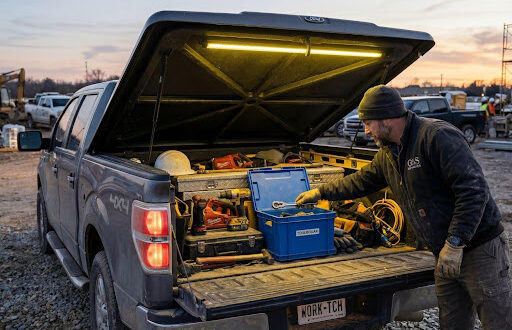
Unlike the majority of 9-5 office workers, contractors don’t get off when the sun goes down. Emergency service calls can come in well past midnight, winter months give you around six-seven hours of daylight, and the job deadlines don’t really care that it’s dark at 5 PM. With all that you can easily find yourself under the truck diagnosing a problem, unloading equipment from the bed, or setting up at a job site in complete darkness.
Of course, your truck headlights get you to the job and factory dome lights allow you to see a cup of hot coffee, but neither helps when you’re actually trying to work. In such conditions the majority of the contractors end up juggling a flashlight in their teeth or burning through their phone battery using it as a flashlight, neither of which is professional or safe.
Poor lighting costs you money and even gets people hurt. When you can’t see what you’re doing, every task takes longer to complete. You make mistakes, drop tools, grab the wrong parts, and waste time searching for stuff that should have been right in front of you. Or even worse, people trip over equipment, misjudge distance, or injure themselves while working blind on tasks that require concentration. OSHA has minimum lighting requirements for job sites and those standards exist for a reason. That’s why professional lighting is a must for any contractor.
Your truck needs three types of lighting to serve the key functions, such as getting you to a job safely, illuminating the job site so your crew can actually see what they’re doing, and the lights for the close-up work around your truck and in the bed like these to organize tools, load equipment, and do paperwork). Installing the right combination of these lights turns your truck into a mobile work platform that functions just as well at 2 AM as it does at 2 PM.
Driving Illumination
Depending on the industry that you work in, reaching a job site may be a challenge in itself, because oftentimes you’re heading to rural properties, construction zones with temporary lighting, or industrial areas where streetlights don’t exist. Factory halogen headlights might be adequate for commuting on city streets and well-lit suburbs, but when you’re towing a trailer down a dirt access road at night or navigating through a poorly marked construction detour you might want to have something brighter.
Headlights
Upgraded headlights with LED headlight bulbs or complete LED housing assemblies run $100-2,000 depending on your truck, and they provide significantly better visibility than halogen units. The light output is whiter and brighter, the beam pattern is cleaner, and they last much longer than halogens. Proper aiming is critical though – poorly aimed HID or LED headlights blind oncoming traffic and make you a hazard. Take the time to adjust them correctly or pay a shop to do it.
Auxiliary Lights
Auxiliary driving lights take things further with roof or bumper-mounted light bars, fog lights, and spot beams as seen on various off-road 4x4s. Quality units from Rigid, Baja Designs, or KC HiLites run $200-800 and provide massive amounts of light. Light bars with flood patterns give you wide coverage to see the edges of roads and spot obstacles. Spot beams throw light hundreds of feet ahead for driving at a higher speed. Fog lights with yellow or selective yellow output cut through dust, rain, and fog better than white lights.
Task-Specific Lighting
Bright LED headlights and light bars are great on the road, but they do nothing when you’re elbow-deep under a hood, digging through your bed in search of a specific tool, or trying to read an invoice in your cab, and that’s a good reason to have targeted lighting right where you need it.
- Under-hood lights are criminally underrated. LED strips that stick to the hood underside or magnetic units that clamp on. Some trigger automatically when the hood opens. Diagnostics, fluid checks, and repairs in the dark go from impossible to easy. If you work on equipment regularly, this pays for itself the first time you don’t drop a bolt into the engine bay because you can actually see.
- Truck bed LED lights are essential for contractors. LED strips along the bed rails triggered by tailgate switch or manual control. Loading and unloading equipment after dark, finding tools buried under tarps, organizing materials – all happen faster when you can see what you’re doing. Wire them to your brake light circuit or run a dedicated switch that would be accessible when you lift a custom or a universal tonneau cover like this: https://www.carid.com/universal-tonneau-covers/
- Cab interior upgrades seem minor until you’re writing invoices at a job site or reviewing plans. Brighter LED dome lights, map lights for paperwork, footwell lighting. Small investment, massive convenience improvement.
- Underbody lighting for guys doing mobile service or frequent inspections. Mount rock lights under frame rails pointing down. Beats crawling under with a flashlight in your mouth.
- Portable backups – quality rechargeable work lights, headlamps for hands-free work, magnetic inspection lights. Always have backups. Batteries die, bulbs fail, stuff breaks.
Lighting Your Work Zone
This is the stuff that actually matters – lights that turn a dark job site into something you can work in. Your crew can’t frame walls, run conduit, or do anything useful if they’re squinting in the dark tripping over equipment.
- Truck-mounted scene lights are the permanent solution. Roof-mounted light bars (20-50″) with flood patterns cover the widest area and mount highest for best coverage. Pod lights give you flexibility to aim multiple directions. Rotating lights let you adjust beam direction without climbing on the truck. Mount them on roof racks, bed rails, rear bumpers, or ladder racks depending on your setup.
- Portable options work if you don’t want permanent mounts or need flexibility. Rechargeable LED work lights on tripods, magnetic units that stick to truck panels, cordless shop lights. Balloon lights for massive areas like full construction sites. Downside is you’re setting up and tearing down every job, batteries die, and stuff gets left behind or stolen.
Power matters here. Hardwire permanent lights to your truck electrical with proper relays and fuses. If you’re running lights for hours with the engine off, you need an auxiliary battery system or you’re walking home with a dead starter battery. Portable units avoid this but check runtime – cheap lights die in 2 hours.
Light It Up Right
Professional contractors lose money sitting idle after dark because they don’t have proper lighting. Start with scene lights to illuminate your work area, add bed LEDs and under-hood lighting for close work, make sure your electrical system handles the load without leaving you stranded with a dead battery.
Quality lights cost more upfront but cheap units fail in six months and leave you working in the dark when you need them most. The safety of your crew and your ability to meet deadlines depend on seeing what you’re doing – invest in lighting or accept that half your day is useless.