KHTS Radio Santa Clarita Radio – Santa Clarita News

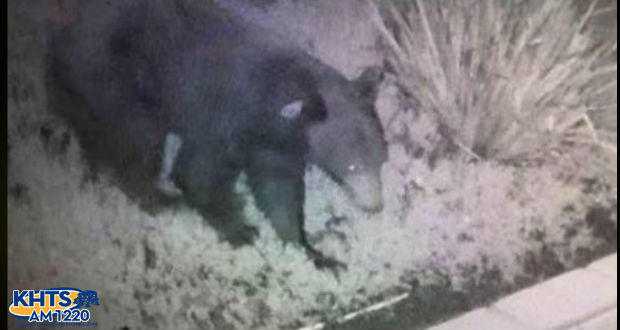
Santa Clarita Valley Sheriff’s Station officials offered a few bear safety tips after another wildlife sighting in Stevenson Ranch.
Sponsored Articles
“We hear the Stevenson Ranch bear is still making his presence known in and about neighborhoods,” according to a Sheriff’s Station Facebook post. “The photo is from a local homeowner.”
The most recent sighting was earlier this week, but they’re not uncommon this time of year, officials say.
A bear sighting alone is not a cause for concern. If a bear causes damage to your home or property, contact the California Department of Fish and Wildlife Regional Office at (562) 598-1032, the post continues.
In fact, a recent interview with a California Fish and Wildlife Department official noted sightings were to be expected this time of year, and offered some information about protocols.
Previous story: Fish And Wildlife Official Discusses ‘People Problem’ After Bear Sightings
If a bear attacks a person, immediately call 9-1-1.
More often than not, the bears, to quote the old adage people usually use about much smaller creatures, “are more afraid of you,” said Andrew Hugan, spokesman for the California Department of Fish and Wildlife.
“Bears are very afraid of people. They’re practically afraid of their own shadow,” Hugan said. However, the problem is, people feed the wildlife near them, either intentionally, or incidentally, which is something they should never do, he added.
“There’s plenty of feed and there’s plenty of water (for bears),” Hugan said, “but would you rather eat bugs or a pizza?” he asked rhetorically. “You live anywhere near a bear habitat (and feed the wildlife), you’re attracting bears.”
In two of the recent visits, the bears went for nearby trash as a food source at a pair of establishments.
However, in both cases, when law enforcement officials were called, the bears left not long after officers arrived. This is common, and it’s why the protocol is for residents, if threatened, to call for a 9-1-1 contact as the first move.
This usually has two results, Hugan said.
Law enforcement officials are required to respond to a public safety threat, and by the time officers arrive, nine times out of 10 the bear likely will have already moved on, Hugan said. If not, the bears are usually scared away by the siren and lights, “99 times out of 100,” he added.
“So that’s always your first response, if you feel threatened,” he noted.
However, if a resident sees a bear from 100 yards, that falls more into the facts of life when living next to a wildlife habitat like we do in Santa Clarita, he added. Such a sighting shouldn’t warrant a call to 9-1-1 or to Fish and Wildlife.
Fish and Wildlife officials recently released a campaign of tips encouraging best practices for residents living near wildlife.
One of the first tips concerns feeding animals:
“You may not realize it – a simple bag of garbage, bowl of pet food, or plate of leftovers left outside your home or vacation site, can cause severe harm to wildlife. Whether you live in a city or a rural part of California, wild animals are your neighbors. Most wild animals will not bother you. They naturally fear humans and keep their distance – so long as they remain fully wild.”
Click here for information from Fish and Wildlife specific to bears.
TIPS for #BearCountry from @SCVSheriff
-Use a bear-proof trash container or wait to put trash out until the morning of collection day. Don’t leave trash, groceries or animal feed in your car.
-Keep garbage cans clean and deodorize them with bleach or ammonia.
-Avoid using bird feeders. They are a powerful attractant.
-Keep BBQ grills clean and keep pet food inside.
-Don’t leave any scented products outside, even non-food items such as suntan lotion, insect repellent, soap or candles.
When wild animals are allowed to feed on human food and garbage, they lose their natural ways – often resulting in death for the animal.
If you encounter a bear in your yard:
Slowly back away. DO NOT approach the bear. Allow the bear plenty of room to pass or withdraw.
Once you are a safe distance away, encourage the bear to leave by banging pots and pans or making other loud noises.
Please respect and protect wild animals — keep them wild.