 KHTS Radio Santa Clarita Radio – Santa Clarita News

By Phyllis Walker, Santa Clarita Elks Lodge 2379
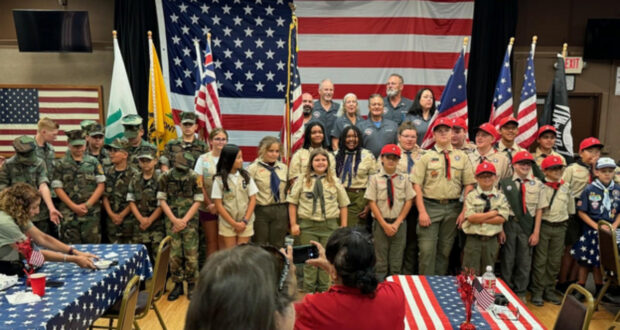
The history of the United States of America Flag was shared by Santa Clarita Elks Lodge 2379 officers at their annual Flag Day Ceremony on June 14 – so timely with Independence Day forthcoming on July 4. The Young Marines and Boy Scout Troops 313 and 583 presented each flag during the ceremony, as described by the officers – from inception to the stars and stripes of today. This presentation was followed by a ceremony showing how to properly dispose of worn and tattered flags that have flown graciously in the community honoring our country’s freedom and are ready to be retired!
Carrying banners has been a custom among all peoples throughout the ages, which usually contain some concept of life or government of those who fashion them. The evolution of the American Flag marks the progression of the government of the American people. From the landing of the Pilgrims in 1620 until 1775, the Flag of England was the Flag of the Peoples of America. The Revolutionary War began April 19, 1775, and ended September 3, 1783, as the colonists began to shape their banner or flag.
The Pine Flag was adopted for all colonial vessels and was the banner carried by the Continental forces in the Battle of Bunker Hill. The Southern colonies used the Snake Flag from 1776 to 1777.
Continental Congress appointed a committee in the latter part of 1775 to consider the question of a single Flag for the thirteen colonies. The committee recommended a design of thirteen alternate stripes of red and white; an azure field in the upper corner contained the red cross of St. George and the white cross of St. Andres. John Paul Jones, senior lieutenant of the flagship “Alfred,” hoisted this Flag to the masthead on December 3, 1775. One month later it was raised over the headquarters of General Washington at Cambridge, Massachusetts, in compliment to the United Colonies. This Flag, called The Continental Colors and The Grand Union, was never carried by Continental land forces, used only by the navy. It was the first American Flag to receive a salute of honor – eleven guns from the Fort of Orange in the Dutch West Indies.
It is generally believed that in May or June 1776, George Washington, Robert Morris and George Ross Commissioned Betsy Ross, a Philadelphia Quaker, to make a flag from a rough design that was provided. Supposedly, she suggested that the stars should have five points rather than six.
July 4, 1776, the thirteen American colonies broke their political connection to the Kingdom of Great Britain by declaring independence. The Declaration of Independence was adopted by the Second Continental Congress at the Pennsylvania State House in Philadelphia. By declaring independence, the states became independent nations.
In response to a general demand for a banner more representative of our country – Congress, on June 14, 1777, stated “That the flag of the United States be thirteen stripes of alternating red and white and the union be thirteen stars, white on a blue field, representing a new constellation”.
This Betsy Ross-designed starry banner was flown at Fort Stanwix (then Fort Schuyler) near Rome, New York, on August 3, 1777; three days later, it was under fire during a British and Indian attack.
The first official salute to the Stars and Stripes on February 14, 1778, was made by France, when the “Ranger” under command of John Paul Jones was saluted by the French fleet on the French coast. This Flag was made by young women of Portsmouth, New Hampshire, from stripes of their best-colored silk dresses and the white wedding gown of a recent bride. It is said this same Flag was flown by Jones’ ship, the “Bon Homme Richard,” in its thrilling fight by moonlight, upon the high seas with the British frigate “Serapis” in 1779.
The original Stars and Stripes represented the original thirteen colonies. In 1796, two additional Stars and Stripes were added to represent the admission of Vermont and Kentucky to the Union. The War of 1812 was fought under this banner. The sight of it flying over Fort McHenry on September 14, 1814, inspired Francis Scott Key to write what became our national anthem—“The Star-Spangled Banner.”
On April 14, 1818, Congress adopted a resolution that on and after July 4, 1818, the number of stripes should be thirteen, and a blue field should carry one star for each of the 20 states in the union; a new star would be added for each state admitted thereafter.
Since 1918, the Flag design has not changed except that 28 new stars were added before July 4, 1912. This Flag of 48 stars flew over the nation for 47 years until just before the Vietnam War. On July 4, 1959, a star was added for Alaska, our first non-connected state; a year later, Hawaii, our island state, added the 50th star.
The display of our present Flag—50 stars and 13 stripes—proudly represents our country. It is at once a history, a declaration and a prophecy. It represents the American nation as it was at its birth, speaks for what it is today, and holds the opportunity for the future.
For more information about Elks Lodge 2379, contact (661)-251-1500 M-F 9 a.m. to 1 p.m. or visit the website.
Sponsored Articles
KHTS FM 98.1 and AM 1220 is Santa Clarita’s only local radio station. KHTS mixes in a combination of news, traffic, sports, and features along with your favorite adult contemporary hits. Santa Clarita news and features are delivered throughout the day over our airwaves, on our website and through a variety of social media platforms. Our KHTS national award-winning daily news briefs are now read daily by 34,000+ residents. A vibrant member of the Santa Clarita community, the KHTS broadcast signal reaches all of the Santa Clarita Valley and parts of the high desert communities located in the Antelope Valley. The station streams its talk shows over the web, reaching a potentially worldwide audience. Follow @KHTSRadio on Facebook, Twitter, and Instagram.






1. With all due respect, according to the U.S. government, there is no proof that Betsy Ross sewed the first Stars and Stripes. The story is based on Ross family lore from 1870 — nearly a century after the Revolutionary War. Although Mrs. Ross sewed flags for 50 years, she sewed flags for Pennsylvania’s navy during the Revolution. Lastly, the so-called “Betsy Ross Flag” dates from the early 1790s — a decade after the Revolutionary War ended. (Source: “Our Flag.” Joint Committee on Printing. United States Congress. H. Doc. 100-247. Washington: U.S. Government Printing Office. 1989. p. 2, https://nps.gov/parkhistory/online_books/flag/h_doc_100-247/index.htm)
2. Scholars now credit Founding Father Francis Hopkinson as the American flag’s designer. (Source: Leepson, Marc. “Flag: An American Biography.” St. Martin’s Griffin. 2005. p. 33)
3. The Flag Manufacturers Association of America (FMAA) issued the following Tweet on February 4, 2021:
FMAA@FMAA_USA – Feb 4
#FlagFact: The designer of the American flag was Francis Hopkinson, a signer of the Declaration of Independence as a delegate from New Jersey.
FMAA_USA.COM
Submitted by Earl P. Williams, Jr., U.S. flag historian (paleovexillologist), Washington, D.C.