KHTS Radio Santa Clarita Radio – Santa Clarita News

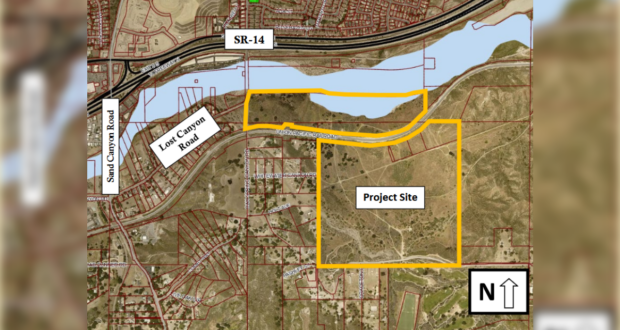
The Santa Clarita Planning Commission continued discussion Tuesday on the proposed Belcaro at Sand Canyon senior housing project, with commissioners and residents alike raising concerns.
The Tuesday hearing marked the latest chapter in the ongoing debate over the 341-home, age-restricted project proposed for Sand Canyon, which has drawn significant opposition from residents who argue it would fundamentally alter the area’s rural character and endanger lives during wildfire evacuations.
Proposed by New Urban West, the Belcaro project would build 341 age-restricted homes on approximately 58.7 acres in Sand Canyon.
Plans also include a roundabout at Sand Canyon and Lost Canyon roads, an extension of Lost Canyon Road to the development, a firefighting helipad, a 1-million-gallon water tank, roadway improvements and more than 100 acres of open space.
“The project brings real benefits to the canyon. It adds much-needed senior housing while replacing raw, unmanaged brush with fire-hardened homes that buffer the existing neighborhood from wildfire. It opens a new dedicated evacuation route connecting Robinson Ranch Road to Lost Canyon Road, including a full-width road under the railroad, giving the canyon a second way out it does not have today, and it replaces the existing always stop with a roundabout that keeps everyday traffic and emergency access moving, and that measurably improves evacuation times for the entire area,” said applicant representative John Musella. “Belcaro doesn’t just add senior homes; it improves conditions the canyon lives with today.”
The commission did not take action on the project Tuesday, instead continuing the hearing to a future date and directing staff to return with the final Environmental Impact Report (EIR) and conditions of approval.
Among the issues raised during the hearing were questions about evacuation routes, the proposed roundabout at Sand Canyon and Lost Canyon roads, school traffic impacts and the extent to which state housing laws limit the city’s ability to deny the project.
Commissioner Pamela Verner raised concerns that the traffic study in the report does not appear to have been updated since 2024 and does not appear to have been conducted during actual school pickup and drop-off times for nearby schools, when traffic would be highest.
“I was just concerned about the traffic study there. The morning traffic counts were taken between 6 and 8 a.m., but Sulphur Springs doesn’t start until 8:45 a.m., and now Santa Clarita Christian is probably starting around that same time. That doesn’t seem to be accounted for in the traffic study,” Verner said.
Verner also questioned how the proposed roundabout would function during peak school traffic and evacuation scenarios, expressing concern that real-world conditions could differ substantially from traffic models.
“The reality is very different than what happens on paper,” Verner said.
Community members continued to oppose the project throughout the hearing, sharing personal experiences from past wildfires and urging commissioners to preserve the canyon’s semi-rural Special Standards District.
Bryan Johnson, a Sand Canyon resident who said he owns two properties in the community, told commissioners he is not opposed to growth but believes infrastructure improvements should come before additional development.
Recalling the 2016 Sand Fire, Johnson described spending hours attempting to evacuate while traffic gridlocked canyon roads. He said conditions became so dire that he released his animals and let them run away alone as flames approached.
“I spray painted my phone number and address on my animals, and let them go, because people could not get into my neighborhood, and the fire department didn’t even know my street existed, because it was Cal Fire (…) no one on my street was even evacuated. Never saw a fire truck. There were 40-foot flames on my fence line.”
Johnson also argued the proposed roundabout would do little to alleviate congestion near nearby schools because children would still need to cross streets while traffic backed up through the intersection.
“If we’re going to do stuff, actually get a plan for the city, and get the infrastructure correct in our neighborhoods before you start building, and have a master plan to build beyond that,” Johnson said.
Stacey Park, a lifelong Canyon Country resident and local business owner, described Sand Canyon as the fulfillment of her late father’s dream.
Park recalled her father driving her through the canyon as a child, pointing out the horses, oak trees and night skies. Years later, she and her husband purchased a home in the community because of the Special Standards District qualities that made the area unique.
Even though she understood the wildfire risks when she moved to the area, Park later lost her home in a fire and spent years fighting with insurance companies while rebuilding.
“I knew what I was buying when I bought there. I knew that evacuation was difficult, and I have lost a home. I lost my Sand Canyon home to a fire. It took us three years to fight the insurance companies and rebuild. Three years, they still owe me $20,000,” Park said.
“I’m not against development. I’m against irresponsible development.”
Bob Kellar, a 47-year Sand Canyon resident, also argued the project conflicts with the area’s Special Standards District, which was established to preserve its rural character.
Kellar said adding 341 homes would increase the number of residences in Sand Canyon by roughly 40% and warned the project would worsen longstanding evacuation and traffic concerns.
“The Belcaro project is totally inconsistent with the special standards district,” Kellar said.
City staff noted that while the Sand Canyon Special Standards District discourages clustered development except in environmentally sensitive areas, state density bonus law supersedes portions of the city’s municipal code.
“As we’ve discussed, the project includes more dwelling units than the city’s zoning allows for, and it clusters development onto smaller lots than the city’s zoning permits. But nevertheless, state law requires that we allow for this, regardless of that special standards requirement,” said City of Santa Clarita Associate Planner Andy Olsen during the project presentation.
Questions about evacuation remained central throughout the evening.
Commissioner Tim Burkhart repeatedly pressed fire officials and traffic engineers on whether the project would worsen evacuation conditions during a wildfire. Burkhart also challenged the reliance on standard traffic engineering metrics when evaluating emergency scenarios.
“I get that the normal traffic volumes probably don’t support (a two-lane roundabout), but the whole purpose of this really is to facilitate the evacuation,” Burkhart said. “I understand the concept of not building a church for Easter Sunday, but Easter Sunday is kind of what we’re all concerned about here.”
Commissioner Lisa Eichman voiced some of the strongest concerns of the night, saying life-safety issues weighed heavily on her evaluation of the project.
“We’re very limited in our job here tonight because of this SB 330… because I don’t want blood on my hands … this looks like people are gonna die here. You know, I don’t want the project. Period. It’s not right,” Eichman said.
Eichman also questioned why the project’s proposed roundabout was designed as a single-lane installation despite anticipated use by trucks, trailers and residents evacuating during emergencies that would benefit from two lanes.
Vice Chair Daniel Faina focused several questions on wildfire mitigation measures proposed by New Urban West and the extent to which development could potentially improve fire safety through fuel modification and fire-hardened construction.
“Which would be safer for the surrounding areas: 200 acres of rural, unkempt landscape, or 200 acres planned, designed fuel-modification for the land and fire-hardening… which would be safer for a wildfire event?” Faina asked fire officials.
Faina also pushed back on the notion that commissioners lacked discretion under state law.
“I believe I understand state law. I don’t think any of us are going to go to jail if we vote no, not based on objective standards. So I don’t think anyone’s hands are tied. The city could be sued by the applicant,” he said.
Planning Commission Chair Nathan Keith focused on how fire-safety features proposed for the project would be enforced over time, questioning whether protections would be incorporated into homeowners association rules or other binding mechanisms.
The commission ultimately voted to continue the hearing, directing staff to return with the final Environmental Impact Report and conditions of approval before any decision is made on the controversial project.
To watch the Santa Clarita Planning Commission meeting, click here.
Sponsored Articles
KHTS FM 98.1 and AM 1220 is Santa Clarita’s only local radio station. KHTS mixes in a combination of news, traffic, sports, and features along with your favorite adult contemporary hits. Santa Clarita news and features are delivered throughout the day over our airwaves, on our website and through a variety of social media platforms. Our KHTS national award-winning daily news briefs are now read daily by 34,000+ residents. A vibrant member of the Santa Clarita community, the KHTS broadcast signal reaches all of the Santa Clarita Valley and parts of the high desert communities located in the Antelope Valley. The station streams its talk shows over the web, reaching a potentially worldwide audience. Follow @KHTSRadio on Facebook, Twitter, and Instagram.