 KHTS Radio Santa Clarita Radio – Santa Clarita News

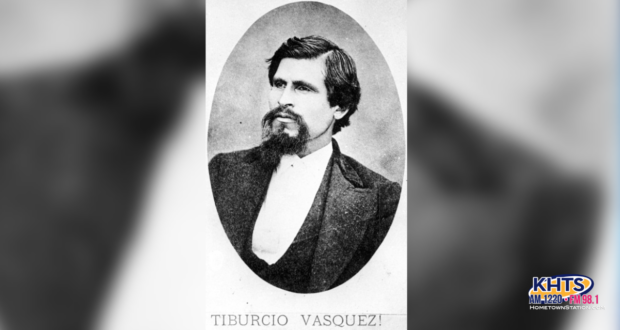
In Santa Clarita history, on March 19, 1875, Tiburcio Vasquez was executed after years of being on the run during a long-term life of crime.
Tiburcio Vasquez was born in Monterey, Alta California, Mexico on April 11, 1835 to Jose Hermenegildo Vasquez and Maria Guadelepe Cantua.
Vasquez grew up in a moderately well-off, middle-class family that owned land, granted to them by the Mexican government, due to his father’s military service as a Spanish soldier.
Vasquez spent plenty of time on his father’s and his Uncle Felipe Vásquez’s ranchos, learning the skills of ranching. He was noted as excellent in marksmanship and horsemanship from a young age.
Vásquez was slightly built, and about 5 feet 7 inches he flourished in Monterey’s early social scene, and he loved to attend the balls and dances that were popular in town.
Vasquez’s family had sent him to a public school established by the government where he became proficient in both English and Spanish, an uncommon skill for the times.
By 1852, Vásquez had become a protégé of Anastacio García, one of California’s most dangerous bandits.
In 1854, Vásquez was present at the slaying of Monterey Constable William Hardmount, during a fight with García at a fandango.
Vásquez denied any involvement in the murder, yet still fled, becoming an outlaw, according to officials.
With Alta California ceasing to exist, and no longer under Mexican governance, thousands of settlers from states and territories further east arrived to claim land in California.
This left many people feeling slighted and forgotten; Vásquez would later claim that his crimes were retribution for discrimination by the settlers and white norteamericanos, insisting that he was a defender of Mexican-American rights.
In 1856, a sheriff’s posse caught up with Vásquez while he was rustling horses near Newhall, and he spent the next five years behind bars in San Quentin Prison.
There, Vásquez helped organize, and participated in, four bloody prison breaks which left twenty convicts dead.
By 1866, he had committed numerous burglaries, cattle thefts, and highway robberies in Sonoma County.
Vasquez was captured after a store burglary in Petaluma and sent to prison again for three years.
Vasquez’s “trademark” was “binding [his victims’] hands behind their back and leaving them face down in the dust.”
For the next 20 years, Vásquez and García played leading roles in Monterey County’s murderous Roach-Belcher feud, ending when García was executed by hanging in 1875.
In 1870, Vásquez organized a bandit gang, which included the notorious Juan Soto and, later, Procopio, Bustamante.
After numerous bandit raids, Vásquez was shot and badly wounded in a gunfight with Santa Cruz police officer Robert Liddell. Vásquez managed to escape, and his sisters nursed him back to health.
In 1873, he gained statewide, and then nationwide, notoriety. Vásquez and his gang stole $2,200 from Snyder’s Store in Tres Pinos, now called Paicines, in San Benito County.
Three were killed, but not by Vásquez. Posses began searching for Vásquez, and Governor Newton Boothe placed a $1,000 reward on his head. Sheriff John H. Adams from San Jose pursued the band to Southern California; Vásquez escaped after a gunfight.
Vásquez hid for a while in Southern California, where he was less well known. With his two most trusted men, he rode over the Old Tejon Pass, through the Antelope Valley, and rested at Jim Hefner’s ranch at Elizabeth Pass.
Vásquez’s brother, Francisco, lived nearby. After resting, Vásquez rode on to Littlerock Creek, which became his first Southern California hideout.
Vásquez returned to the San Joaquin Valley. On November 10, 1873, he and his gang robbed the Jones store at Millerton in Fresno County.
On December 26, 1873, he and his band sacked the town of Kingston in Fresno County, robbing all the businesses and making off with $2,500 in cash and jewelry.
Governor Booth was now authorized by the California State Legislature to spend up to $15,000 to bring the law down on Vásquez.
Posses were formed in Santa Clara, Monterey, San Joaquin, Fresno, and Tulare counties, according to officials.
In January 1874, Booth offered $3,000 for Vásquez’s capture alive, and $2,000 if he was brought back dead.
These rewards were increased in February to $8,000 and $6,000, respectively. Alameda County Sheriff Harry Morse was assigned specifically to track down Vásquez.
Heading towards Bakersfield, Vásquez and gang member Clodoveo Chávez rode to the rock promontory near Inyokern, now known as Robbers Roost.
Near that spot, at Coyote Holes, they robbed a stagecoach from the Cerro Gordo Mines near Owens Lake of its silver. During the robbery, Vásquez shot and wounded a man who did not obey his orders.
The gang moved to Elizabeth Lake and Soledad Canyon, robbing a stagecoach of $300, stealing six horses and a wagon near present-day Acton, and robbing lone travelers.
Vásquez was believed to be hiding out at what are now known as Vásquez Rocks. Shallow caves, deep crevices, and numerous overhangs created a maze for any posse to thread. The tallest rock, 150 feet (46 m) high, provided an excellent lookout point.
For the next two months, Vásquez escaped attention. However, he then made an error that led to his capture.
On April 15, 1874, he and his band held the prominent sheepman Alessandro Repetto for ransom. Pursuing posses from Los Angeles almost trapped the gang in the San Gabriel Mountains, but once again, Vásquez and his men escaped.
Vásquez took up residence at the adobe home of “Greek George” Caralambo in the northwest corner of Rancho La Brea, located 200 yards (183 m) south of the present-day Sunset Strip in West Hollywood.
Greek George was a former camel driver in the Army Camel Corps. Allegedly, Vásquez seduced and impregnated his own niece.
Either the girl’s family or Greek George’s wife’s family betrayed Vásquez to Los Angeles County Sheriff William R. Rowland.
Rowland sent a posse to the ranch and captured Vásquez on May 14, 1874. Greek George’s adobe was situated near the present-day Melrose Place in West Hollywood, very close to where the movie industry set up shop a few decades later.
Vásquez remained in the Los Angeles County jail for nine days, officials added.
In late May, Vásquez was moved by steamship to San Francisco. He eventually stood trial in San Jose. Vásquez quickly became a celebrity among many of his fellow Hispanic Californians. He admitted that he was an outlaw, but again denied he had ever killed anyone.
In January 1875, Vásquez was convicted and sentenced to hang for murder. His trial had taken four days and the jury deliberated for only two hours before finally finding him guilty of one count of murder in the Tres Pinos robbery.
Click here to view yesterday’s Today in History.
Sponsored Articles
KHTS FM 98.1 and AM 1220 is Santa Clarita’s only local radio station. KHTS mixes in a combination of news, traffic, sports, and features along with your favorite adult contemporary hits. Santa Clarita news and features are delivered throughout the day over our airwaves, on our website and through a variety of social media platforms. Our KHTS national award-winning daily news briefs are now read daily by 34,000+ residents. A vibrant member of the Santa Clarita community, the KHTS broadcast signal reaches all of the Santa Clarita Valley and parts of the high desert communities located in the Antelope Valley. The station streams its talk shows over the web, reaching a potentially worldwide audience. Follow @KHTSRadio on Facebook, Twitter, and Instagram.






Aye aye aye,
They hung the frito bandito.