KHTS Radio Santa Clarita Radio – Santa Clarita News

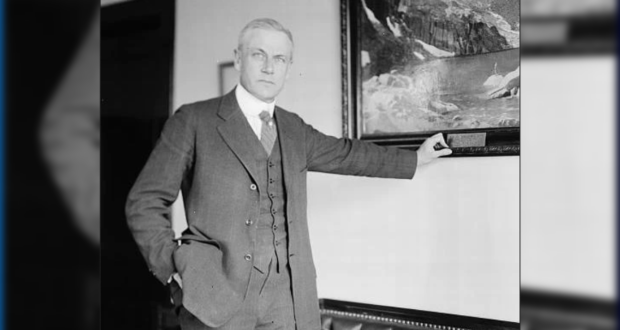
On Jan. 21, 1915, Stephen Tyng Mather, an industrialist whose fortune was built in the borax mines of Tick Canyon in today’s eastern Santa Clarita Valley, was sworn in as Assistant to the U.S. Secretary of the Interior.
Mather, a Chicago businessman and University of California, Berkeley graduate, had made his first million through borax mining operations in Tick Canyon near Agua Dulce.
In 1905, prospectors Louis Ebbenger and Henry Shepard discovered a rich deposit of colemanite, a form of borax, in the canyon.
Unable to develop the claim themselves, they sold it to Thomas Thorkildsen, Mather’s business partner, for $80,000.
Together, Thorkildsen and Mather operated the Thorkildsen-Mather Borax Company, later known as the Sterling Borax Company.
The mine supported the nearby boomtown of Lang, a short-lived settlement that vanished after the mine closed in 1921.
Today, remnants of the Sterling Borax operation remain near Davenport Road, where the site is fenced off and owned by Rio Tinto Minerals, a successor to Pacific Coast Borax and U.S. Borax.
On the north side of the road stands a familiar “No Trespassing” sign, while to the south lies the wash from the old mine. Samples of colemanite — discarded as worthless during mining operations — can still be seen along the roadside.
By 1914, Mather was wealthy, restless, and searching for a new challenge.
An avid outdoorsman and mountaineer influenced by naturalist John Muir, Mather grew increasingly frustrated with the poor condition and fragmented management of America’s national parks, which were scattered among various federal agencies and often controlled by private toll roads and mining interests.
After writing a letter criticizing the state of the parks, Mather received a now-famous response from Secretary of the Interior Franklin K. Lane, a former college classmate, who encouraged him to come to Washington and “run them yourself.” Mather accepted.
With Horace Albright handling bureaucratic matters, Mather began work on Jan. 21, 1915, at a modest government salary.
Over the next year, he used his personal wealth, political connections, and relentless energy to build public and congressional support for a unified national parks agency. He hosted large gatherings of journalists, lawmakers, and civic leaders, and even funded park improvements out of his own pocket, including the purchase and donation of Yosemite’s Tioga Road to the federal government.
Mather’s efforts culminated on Aug. 25, 1916, when President Woodrow Wilson signed the National Park Service Organic Act into law.
The act mandated that national parks be preserved “unimpaired for the enjoyment of future generations,” and Mather was named the first director of the National Park Service.
Under Mather’s leadership, the park system expanded dramatically, laying the groundwork for the more than 400 national parks, monuments, and historic sites that exist today.
He served as director until a debilitating stroke forced his retirement in 1929.
In 1932, bronze plaques honoring Mather were installed at several national parks, bearing the inscription: “There will never come an end to the good that he has done.”
For yesterday’s Today in SCV History, click here.
Sponsored Articles
KHTS FM 98.1 and AM 1220 is Santa Clarita’s only local radio station. KHTS mixes in a combination of news, traffic, sports, and features along with your favorite adult contemporary hits. Santa Clarita news and features are delivered throughout the day over our airwaves, on our website and through a variety of social media platforms. Our KHTS national award-winning daily news briefs are now read daily by 34,000+ residents. A vibrant member of the Santa Clarita community, the KHTS broadcast signal reaches all of the Santa Clarita Valley and parts of the high desert communities located in the Antelope Valley. The station streams its talk shows over the web, reaching a potentially worldwide audience. Follow @KHTSRadio on Facebook, Twitter, and Instagram.