KHTS Radio Santa Clarita Radio – Santa Clarita News

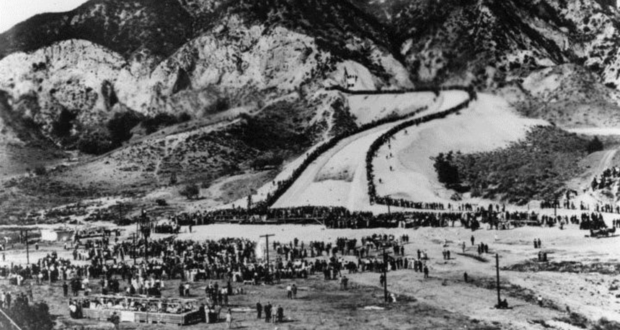
On November 5, 1913, California unveiled its most ambitious engineering project to date: the Los Angeles Aqueduct.
Millions of gallons of water from the Owens Valley cascaded down the Newhall Pass into the newly built Van Norman Reservoir, forever transforming Los Angeles and the Santa Clarita region.
Los Angeles had rapidly outgrown its origins as the small 44-person Spanish settlement of El Pueblo de Nuestra Señora la Reina de los Ángeles, built with the forced labor of indigenous Tongva Yaangavit.
By the mid-1800s, the city’s population was rising, and its early water systems, first the open-air Zanja Madre and later an enclosed iron pipeline in 1880, struggled to keep pace.
By 1902, with more than 100,000 residents and demand far exceeding the capacity of the Los Angeles River, the city turned to a drastic solution.
Years before, in the 1890s, former Los Angeles Mayor Fred Eaton had visited the fertile Owens Valley on the other side of the Sierra Nevada, home to towns like Bishop and Lone Pine, known then as “The Switzerland of California,” and envisioned diverting its water hundreds of miles south.
Working with William Mulholland, superintendent of the city’s water system, the two embarked on a controversial plan to secure Owens Valley land and water rights. Through a series of underhanded deals and political maneuvering, including misleading federal officials and valley residents, Los Angeles quietly gained control of the Owens River.
Construction on the aqueduct began in 1908. Stretching 233 miles and powered entirely by gravity, the system cut through San Francisquito, Bouquet, and Soledad canyons, including the five-mile Lake Elizabeth tunnel.
Against the odds, Mulholland completed the project on time and on budget in 1913.
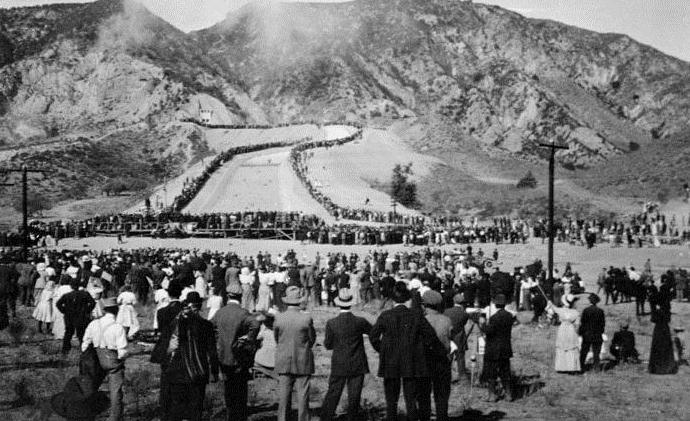
Over 40,000 spectators gathered at the Cascades near present-day Sylmar to witness the first water flow into Los Angeles. Mulholland gave the famous command: “There it is, take it.”
The Los Angeles Times proclaimed the next day: “Glorious Mountain River Now Flows To Los Angeles.” The following day, November 6, Exposition Park was dedicated as part of the celebrations.

The Los Angeles Aqueduct transformed the city’s future. But it came at great cost. After Los Angeles City was blocked from pulling additional water from the Colorado River, the aqueduct drained the Owens Valley dry.
Owens Lake was gone by 1924, and green orchards gave way to arid desert, devastating the area economically.
To this day, the area is plagued by alkali dust storms filled with particulate carcinogens like arsenic, cadmium and nickel.
Mulholland’s shining reputation shifted dramatically fifteen years later, when the St. Francis Dam in San Francisquito Canyon, part of the same water system, collapsed in 1928, becoming the deadliest civil-engineering failure of the 20th century. But that is a story for another day in SCV History.
To read yesterday’s Today in History, click here.
Sponsored Articles
KHTS FM 98.1 and AM 1220 is Santa Clarita’s only local radio station. KHTS mixes in a combination of news, traffic, sports, and features along with your favorite adult contemporary hits. Santa Clarita news and features are delivered throughout the day over our airwaves, on our website and through a variety of social media platforms. Our KHTS national award-winning daily news briefs are now read daily by 34,000+ residents. A vibrant member of the Santa Clarita community, the KHTS broadcast signal reaches all of the Santa Clarita Valley and parts of the high desert communities located in the Antelope Valley. The station streams its talk shows over the web, reaching a potentially worldwide audience. Follow @KHTSRadio on Facebook, Twitter, and Instagram.