 KHTS Radio Santa Clarita Radio – Santa Clarita News

Sanitation District officials released their plan for an alternative chloride removal project to be presented at an upcoming meeting May 20.
Sponsored Articles
The new proposal, pending board approval later this month, would allay Westside concerns over the construction of deep well sites, which was planned near the 16th hole of a golf course.
The Santa Clarita Valley Sanitation District Governing Board directed staff to find an alternative site or plan that complies with the state’s mandated deadlines, after dozens showed up to a meeting in Santa Clarita to decry a plan to build a brine well next to the Valencia TPC.
The cost of the proposed alternative is expected to be close to the previously approved deep well injection plan, about $130 million, according to district officials.
There are no anticipated rate increases associated with the change in plans, said Phil Friess, head of Technical Services of the district. The governing board approved rate increases associated with a previous chloride removal option last year, and district officials do not anticipate any adjustments to the previously approved schedule, based on the new proposals.
Due to the constraints of a looming state deadline, district staffers are proposing to abandon deep well injection plans for a combination of previously approved options, officials said.
“The conclusion we reached, based on the levels of analysis we did is we would be unable to implement DWI (deep well injection) or a brine pipeline to meet the timeline we have,” Friess said. “The only method of brine management that we think we can still implement by July 2019, our final compliance deadline, would be some form of brine minimization and truck hauling.”
The plan would essentially be to increase the treatment level at local plants, and then truck the chloride that’s been removed to “an established industrial area.”
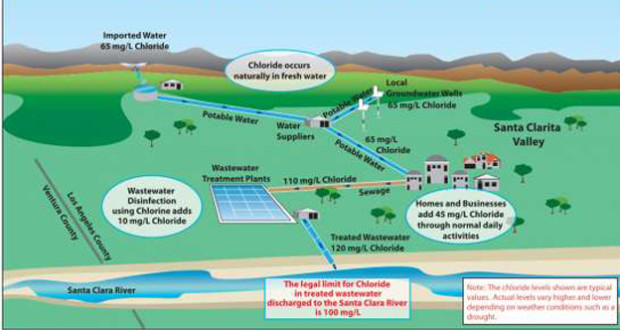
Chloride, or brine, are terms for the salt removed from chloride that’s often added to water through soaps and other household chemicals.
The state is requiring SCV Sanitation District to reduce the amount of chloride in the water the district treats and then sends downstream to Ventura County, to 100 milligrams per liter, for the long-term protection of agricultural interests in that area, because the crops are reportedly salt-sensitive.
The next step, if the treatment and trucking options are approved, would be to submit the plan for an environmental review, officials said.
“Pending Board direction, staff will proceed with an environmental review to comply with CEQA including an alternatives analysis,” according to a Sanitation District statement. “The CEQA process would commence this summer with a public scoping meeting, followed by information meetings this fall to provide an update on the overall project.”
The project timeline for board consideration is expected to be summer 2016.
From a previous story on the deep well injection plan (March 12, 2015):
Santa Clarita Valley Sanitation District officials are “starting over” in their search for a new deep well site Wednesday, after protest from a Westside crowd wanting the county agency to look for a new plan altogether.
“The board clearly directed us to go identify a different site,” said Ray Tremblay, Sanitation Districtspokesman, “so we absolutely are not using the Stevenson Ranch or Westridge sites at all. They’ve directed us to go find a new place to go and implement the project.”
“We have to start over and find a different site, so it puts us back to square one on that part of the project,” Tremblay said. “We’re still making great progress on implementing the treatment part of the plan.”
Sanitation District staff now has “to start over and re-evaluate (the plans) with a clean slate,” Tremblay said, adding staff also is seeking to determine if another well site is even feasible.
The Los Angeles Regional Water Quality Control Board, a state agency established by the EPA’s Clean Water Act that sets the standard for the amount of chloride — or salt, and other chemicals — that can be in water we send downstream, is overreaching with the 100 milligrams/liter chloride limit, Antonovich said.
District staff would know more after a new “initial study” is undertaken, which is aCalifornia Environmental Quality Actrequirement, he said.
County Supervisor Michael Antonovich questioned a state water official on what he called the “arbitrary” nature of the chloride limit, and whether the county had the recourse to fight.
To that end, he even asked if the legal counsel who spoke on behalf of the corporate objectors of the well plan, such as Princess Cruise andBoston Scientific, if they’d helped litigate to the fight against the chloride limit set by the state.
“The is a case of regulatory agencies going above and beyond the regulations that those legislative bodies have set,” Antonovich said. “We’re trying to come to a reasonable solution while dealing with an unreasonable regulatory agency.”
The Los Angeles Regional Water Quality Control Board, a state agency established by the EPA’sClean Water Act that sets the standard for the amount of chloride — or salt, and other chemicals — that can be in water we send downstream, is overreaching with the 100 milligrams/liter chloride limit, Antonovich said.
He argued the limit and subsequent costs to abide by the limit being put on Santa Clarita Valley Sanitation District was onerous and amounted to taxation without representation. He also asked if the state board would hold a meeting in the Santa Clarita Valley.
“You have the right to face your accuser,” Antonovich said. “This is due process.”
Sam Unger, executive director for the state’s RWQCB, stated the board’s position — that scientifically tested data supported the 100 mg/l limit in order to repair salt damage to water in the Piru Basin in Ventura County, which is where Santa Clara River effluence goes after leaving local treatment plants.
While the Sanitation District has the ability to start over on the chloride treatment project, Unger said, the RWQCB would expect the county agency to abide by the schedule it agreed to in its last fine settlement.
The state board already granted the district a four-year extension for abiding by the chloride limit, he said, after district ratepayers rejected the Alternative Water Resources Management plan in 2010. Cost was the determining factor in the plan’s demise.
In 2012, SCV Sanitation District ratepayers were fined more than $200,000 for not hitting a previous schedule for the approval of a project to remove chloride.
In 2013, SCVSD staff released studies suggesting deep well injection — the pumping of excess chloride into a series of wells about two miles into the earth — would be the cheapest option.
However, an 11th hour change earlier this year due to a planning mistake by Sanitation District staff left the agency to use a site near the 16th hole of Valencia TPC. The land originally slated for the well project was denied due to a conservation easement by county officials put in before the well plan’s approval.
Do you have a news tip? Call us at (661) 298-1220, or drop us a line at [email protected].






Why are we dumping the treated water into the Santa Clara river? We should be pumping it upstream to be re-released into the ground water system, or at least using it for irrigation and other non-potable uses. Everyone’s complaining about the drought and water restrictions — let’s use this water. Think long-term!