KHTS Radio Santa Clarita Radio – Santa Clarita News

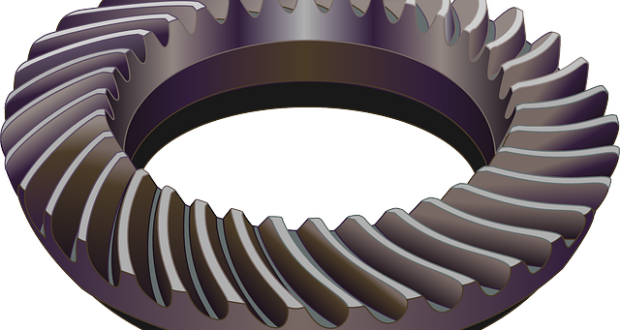
In plastic, and metal fabrication industries, operators remain constantly at risk of harm from sharp edges of 90° angle tools, equipment, and manufacturing parts. The removal of these sharp edges has become a constant concern. For transforming these tipped corners, mechanics usually create chamfers or bevels to prevent damage and injuries.
Even though bevel and chamfer are employed by custom CNC milling machines, and are often misunderstood as the same, there are clear distinctions between the two terms. Therefore, it’s quite important to understand the difference between bevel, and chamfer.
What is Bevel?
In technical terms, a bevel refers to a hypotenuse sloped plane that is tilted between an object’s two parallel surfaces. To meet the opposing surface, a bevel generates an inclined surface at a steep angle of 45°. As a result, a seamless diagonal corner is produced.
The primary function of bevel cut is to ameliorate wear resistance, safety, and aesthetics of the intended machined parts. Bevel cuts are normally shaped through custom CNC milling process. A tool named as “bevel tool” is used to form bevel cuts. Product manufacturers employ bevel cuts for modifications to create desired parts or products. Additionally, bevel cuts found significant use in cutting tools, and bevel edges, and enhancing the aesthetics of manufactured parts.
What is Chamfer?
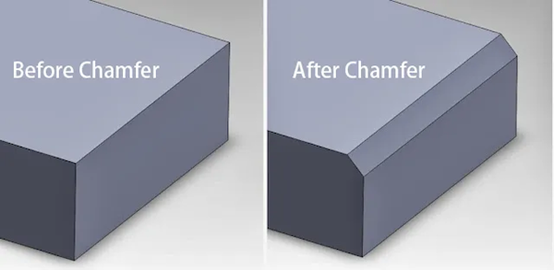
A chamfer is a common term used in mechanical engineering that means cutting or removal of material from the intended workpiece. It refers to a slope or transitional edge between the two adjacent surfaces of the same part.
These can be formed inside (concave), or outside (convex) Usually, chamfers reduce the time to cut the parts at right angles and exhibit the ability to prevent dust accumulations on the part surface. Contrary to bevel, a chamfer is always designated at a 45° angle to eliminate sharp edges from a 90° angle workpiece. Manufacturers use a tool or “chamfering cutter” to shape chamfers or bevels in a workpiece.
Moreover, chamfer edges are used for connotative glass mirrors and printed circuit boards (PCB) designs. In addition, chamfering can help reduce tail-off of handling accidents. Furthermore, it enhances the part’s overall durability, and longevity. Tabletops and countertops are a few examples of furniture with chamfered edges that serve as protection for users from accidents and injuries.
Predominantly, chamfers are made through turning mills, in the case when cuts are needed on top to bottom alignments of job pieces, double-end mill chamfers are recommended to be employed to meet parts specifications without turning.
Let’s evaluate both terminologies from the perspective of their methods of measurement shapes, connotations, and machining methods.
Measurement Methods
An optical comparator helps calculate bevel and chamfer angles. It has a magnifying lens that shows the inclination of the sloped surface. Digital and analog are the two varieties that are offered. A bevel protractor is another tool, especially used to measure bevel angles.
Chamfers, in contrast, are typically measured using the length of the diagonal section that has been removed from the intended machined part. Alternatively, it can be measured using the angle that remains after a specific amount of the material is removed. They are given in both degrees and millimeters; for example, 2 mm or 45-degree chamfers.
A tool used to measure the size of chamfers is a chamfer gauge. The chamfer is placed on its sloping surface to measure it. It could be digital or analog. The chamfering ruler, another tool to perform a similar function is specifically designed for an L-shaped steel scale set on the edge of the chamfer to measure its dimensions.
Difference in Shape
When seen from the middle, a bevel resembles a rhombus. Any acute angle (less than ninety degrees) or obtuse angle (more than ninety degrees).
In contrast, an octagonal shape is produced when an edge is chamfered and inspected in the center. Cutting a chamfer needs an exact 45-degree angle, and allows cheaper tools to form cuts.
Based on Connotation
Bevel tends to refer to a more methodical approach to work. For aesthetic or functional reasons, such as increased strength or better material flow control, beveled edges are often employed.
On the other hand, “chamfer” typically suggests a more hands-on strategy. Since chamfering requires the removal of material, cutting is typically of utmost importance. Chamfers are mostly applied in safety applications where the structural stability of an object is integral. Further, it reduces the likelihood of handling-related mishaps.
Machining Methods
Numerous machining techniques may be used to create bevels and chamfers. The optimal technique is determined by various factors such as part geometry, required size, and the precision of the edge.
Bevels are made with specialized equipment including, beveling machines, milling cutters, or custom CNC milling that can precisely cut angles. Rotational symmetry allows parts to be turned on lathes to create beveled edges. The right procedure is determined by the material and corresponding needed angle.
Chamfers, on the other hand, are made with a variety of equipment, such as custom CNC milling, and power tools like routers, that have been equipped with chamfer end mills. Drilling or grinding tools can be used to create chamfers for specific uses or tiny features. For the material to have the appropriate size or angle along the edge, it must be eliminated.
Conclusion
Although they both result in sloping surfaces, bevels and chamfers have different uses in engineering, manufacturing, and custom CNC milling. While chamfers strengthen the structure and emphasize safety. Generally speaking, these minor edge adjustments have a big impact on how well the finished product can balance functionality, safety, and aesthetics. Both are widely adopted in construction and woodworking applications, where fine and aesthetic corners are required.
Machine shops should figure out critical facts before considering them in designs. Their primary objective is to enhance aesthetic features, rather than function, so they increase the cost per part.