KHTS Radio Santa Clarita Radio – Santa Clarita News

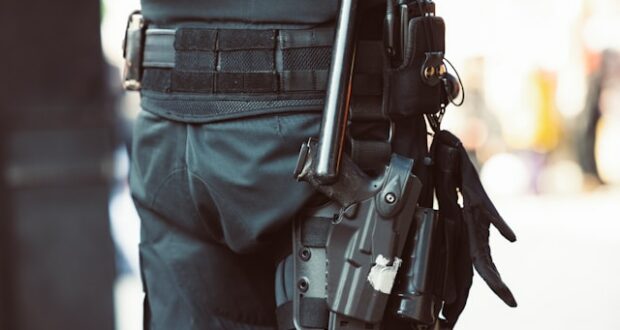
When a Santa Clarita Valley Sheriff’s deputy walks up to a call, they are carrying close to 30 pounds of equipment on their waist. Most community members have never looked closely at what is on that belt, or why each piece is positioned where it is.
This guide breaks down the modern duty belt and the design thinking behind a system that has to work instantly under stress.
What the duty belt actually does
A duty belt is a load-bearing platform. It holds tools an officer or deputy may need to access in seconds, from a sidearm to a radio to a tourniquet.
Modern belts are engineered for weight distribution, rapid access, and long-shift comfort.
The standard gear load
Most patrol deputies carry a fairly consistent set of items. The exact list varies by department policy, but the core stays the same across agencies.
Typical items include a sidearm with at least two spare magazines, handcuffs, a Taser, pepper spray, a collapsible baton, a portable radio, a flashlight, gloves, and a tourniquet.
Fully loaded, that belt can run from 15 to 30 pounds. That weight is carried for an entire shift, often from inside a patrol vehicle seat.
Comparison: Common duty belt setups
| Setup | Material | Weight | Comfort | Common users |
| Leather belt keeper system | Leather | Heavier | Stiff | Traditional agencies |
| Nylon belt keeper system | Nylon | Medium | Moderate | Many patrol agencies |
| Inner/outer Velcro system | Nylon | Lightest | Highest | Modern LE, tactical |
| Load-bearing vest | Nylon carrier | Redistributed | Back-friendly | Agencies addressing injuries |
Why placement matters
Police trainers emphasize that equipment placement is not arbitrary. It is designed to prevent cross-grabs under stress and to keep the body balanced.
The sidearm sits on the strong-side hip. Magazines and the Taser go on the support side so a deputy is never reaching to the same side for two different tools.
Handcuffs often ride on the front center, accessible with either hand. Nothing hard should sit on the lower back, where it digs in during a patrol shift.
The belt itself has evolved
Leather duty belts were standard for decades. They looked sharp, but they were heavy and slow to adjust.
Many modern departments run a dual-layer setup. An inner belt threads through pant loops, and an outer gear belt attaches with hook-and-loop, eliminating belt keepers entirely.
This approach has become popular because it reduces sag, speeds up donning and doffing, and cuts pressure points across a long shift.
A look at what a modern system offers
Companies focused on officer comfort have leaned into rigid nylon construction, lifetime warranties, and fit guarantees. The goal is a belt that carries the same 20 pounds of gear without the shifting and back pain that older systems caused.
For example, duty belts from Safe Life Defense use a dual-layer design with a locking inner and outer belt, are rated as ultra-rigid without metal reinforcement, and ship with a lifetime warranty and a 30-day fit guarantee.
Made-in-USA construction and published sizing guidance are minimum expectations for deputies buying off-duty replacements.
Expert perspective
Police1, a leading law enforcement publication, notes that poor weight distribution on a duty belt contributes to lower back pain and posture problems that shorten careers.
ASP, Inc., which trains officers nationwide, writes that comfort during patrol car shifts is as important as accessibility, because gear digging into the back will be relocated or removed, which can compromise safety.
The clear theme in trainer guidance is balance. Everything heavy should be paired with something of similar weight across the belt.
Watch: How officers set up a duty belt
This walkthrough, filmed by two working officers, shows how placement decisions are made in practice:
Local context
The Santa Clarita Valley Sheriff’s Station covers one of the largest patrol areas in Los Angeles County. Deputies here are regularly featured in Hometown Station’s reporting on community events and crime response.
Community organizations like the SCV Sheriff’s Foundation help fund equipment and technology that supports these deputies. Duty gear replacement is part of that broader cost-of-policing conversation.
What civilians should know
Duty belts are not limited to sworn officers. Security professionals, range instructors, and some civilians use similar belts for organized, safe firearm carry.
Civilian buyers should look for a written fit guarantee and a return policy that covers reasonable testing in real use. A poorly fitted belt is the most common complaint across reviews, regardless of brand.
Frequently Asked Questions
How much does a fully loaded duty belt weigh?
For most patrol deputies, 15 to 25 pounds. Specialty assignments can push that higher with additional medical or tactical gear. Modern tactical battle belts are engineered for weight distribution, rapid access, and long-shift comfort.
Why do some deputies wear a load-bearing vest instead?
A load-bearing vest shifts weight from the hips to the shoulders, reducing lower back strain. Some agencies have adopted them specifically to address long-term officer injuries.
Can civilians buy the same belts deputies use?
Yes. Most major duty belt manufacturers sell directly to civilians. The belt itself is not regulated. Holsters and certain accessories may have state-level considerations.
How often should a duty belt be replaced?
Leather belts typically last several years with care. Nylon belts with hook-and-loop systems can last the life of the officer with proper rotation, though heavy daily use may require the loop side to be refreshed sooner.
Further reading on Hometown Station
For local context, see Hometown Station’s coverage of the SCV Sheriff’s Foundation and the First Responders Statue Project honoring local deputies, firefighters, EMTs, and CHP officers.
Final thoughts
A duty belt looks simple from across a parking lot. Up close, it is the result of decades of training doctrine, injury research, and equipment evolution.
Every pouch has a reason. Every placement decision trades something for something else. That belt tells a story about the job, long before any words are spoken.