KHTS Radio Santa Clarita Radio – Santa Clarita News

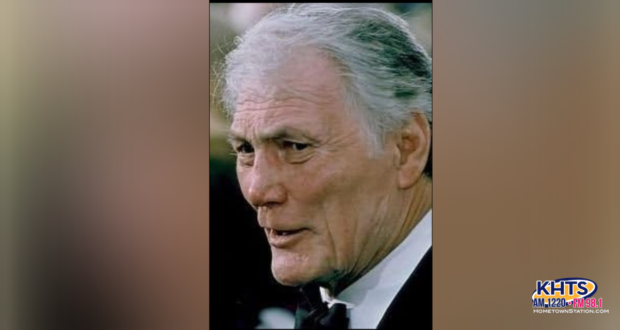
Saddle up for a trip through entertainment history with a weekly highlight from Santa Clarita’s Walk of Western Stars! This week, actor Jack Palance.
Palance was born on Feb. 18, 1919, in Lattimer Mines, Pennsylvania, the son of Anne and Ivan Palahniuk, an anthracite coal miner.
Palance’s parents were Ukrainian Catholic immigrants, his father a native of Ivane-Zolote in southwestern Ukraine and his mother from the Lviv Oblast.
One of six children, Palance worked in coal mines during his youth before becoming a professional boxer in the late 1930s.
Palance enlisted in the United States Army Air Forces during World War II and was trained as the pilot of a B-24 Liberator Bomber.
Palance suffered head injuries and burns during a 1943 crash, with various sources citing it as a patrol off the coast of California or a training flight near Tucson, Arizona.
Palance was discharged in 1944 after undergoing reconstructive surgery, which contributed to his distinctively gaunt appearance.
After his time in the Air Force, Palance received a football scholarship to the University of North Carolina at Chapel Hill but left after two years, disgusted by the commercialization of the sport.
Later, Palance enrolled at Stanford to study journalism, but switched to drama, according to officials.
During his university years, Palance worked as a short order cook, waiter, soda jerk, lifeguard at Jones Beach State Park and a photographer’s model.
Palance left one credit shy of graduating to pursue a career in the theatre.
In New York, Palance studied method acting under Michael Chekhov, while working as a sportswriter.
The actor made his Broadway debut in 1947 as a Russian soldier in “The Big Two,” directed by Robert Montgomery.
Palance’s acting break came as Marlon Brando’s understudy in “A Streetcar Named Desire,” and he eventually replaced Brando on stage as Stanley Kowalski.
Palance appeared in two plays in 1948 with short runs, “A Temporary Island” and “The Vigil,” making his television debut in 1949.
Palance made his big-screen debut in “Panic in the Streets” (1950), directed by Elia Kazan, who had directed Streetcar on Broadway.
That same year the actor was featured in “Halls of Montezuma” (1951), about the United States Marines during World War II.
Palance returned to Broadway for Darkness at Noon (1951) by Sidney Kingsley, which was a minor hit.
Palance played a villain in “Second Chance” opposite Robert Mitchum and was an Indian in Arrowhead and got the chance to play a heroic role in “Flight to Tangier” in 1953.
In 1955, Palance had the star part in “I Died a Thousand Times,” which is a remake of “High Sierra,” and was cast by Robert Aldricj in two more star parts: “The Big Knife”, from the play by Clifford Odets, as a Hollywood star; and “Attack (“1956), as a tough soldier in World War II.
Palance was in a western, “The Lonely Man” (1957), playing the father of Anthony Perkins, and played a double role in “House of Numbers.”
In 1957, Palance won an Emmy Award for Best Actor for his portrayal of Mountain McClintock in the Playhouse 90 production of Rod Serling’s “Requiem for a Heavyweight.”
The actor became an international in 1958 when he played the role of a hero in “The Man Inside,” as the production was shot in Europe. He also filmed “Ten Seconds of Hell” in 1959.
In 1960, Palance also filmed in Mexico, Austerlitz and a series of films in Italy, according to officials.
In 1963, Palance returned to the U.S. to star in the TV series “The Greatest Show on Earth.”
The actor played a gangster in “Once a Thief” (1965), and in the following year, he appeared in the television film “Alice Through the Looking Glass.”
Palance guest-starred in “The Man from U.N.C.L.E. ,” and the episodes were released as a film, “The Spy in the Green Hat” (1967).
Palance provided narration for the 1967 documentary “And Still Champion! The Story of Archie Moore” and was in the TV film “The Strange Case of Dr. Jekyll and Mr. Hyde” produced by Dan Curtis, during the making of which he fell and injured himself.
In 1969, Palance recorded a country music album in Nashville, released on Warner Bros. Records.
It featured his self-penned song “The Meanest Guy That Ever Lived”. The album was re-released on CD in 2003 by the Water label (Water 119).
Palance’s films were often international co-productions by this time: “They Came to Rob Las Vegas,” “The Mercenary” (1968), “The Desperados” and “Marquis de Sade Justine” (1969).
Palance had a part in the Hollywood blockbuster “Che!” (1969) playing Fidel Castro opposite Omar Sharif in the title role, but the film flopped.
Palance went back to action films and “Westerns: Battle of the Commands” (1970), “The McMasters” (1970) and “Companeros” (1970).
In Great Britain, he appeared in a highly acclaimed TV film, “Bram Stoker’s Dracula” (1973), in the title role, directed by Dan Curtis.
Palance returned to Hollywood for “Oklahoma Crude” (1973), then to England to star in “Craze” (1974).
The actor starred in the television series “Bronk” between 1975 and 1976 for MGM Television, and starred in the TV films “The Hatfields and the McCoys” (1975) and “The Four Deuces” (1976).
Palance’s final films included Ebenezer (1998), a TV Western version of Charles Dickens classic “A Christmas Carol,” with Palance as Scrooge; “Treasure Island” (1999); “Sarah, Plain and Tall: Winter’s End” (2000) and the “Prancer Returns” (2001).
In 2001, Palance returned to the recording studio as a special guest on friend Laurie Z’s album Heart of the Holidays to narrate the classic poem “The Night Before Christmas.”
In 2002, the actor starred in the television movie “Living with the Dead” opposite Ted Danson, Mary Steenburgen and Diane Ladd.
In 2004, he starred in another television production, “Back When We Were Grownups,” once again directed by Ron Underwood, opposite Blythe Danner; it was his final performance.
Palance lived for several years around Tehachapi, California and was married to his first wife Virginia from 1949 to 1968 until her death on New Year’s Day in 2003 when she was struck and killed by a car in Los Angeles. The two shared three children together.
Where is Jack Palance’s Plaque on the Walk of Western Stars ?
In 1993, Palance was honored with a plaque on the Walk of Western Stars. The plaque is on the east side of Main Street on the corner of Main Street and 6th Street.
To view last week’s feature, click here.
Sponsored Articles
KHTS FM 98.1 and AM 1220 is Santa Clarita’s only local radio station. KHTS mixes in a combination of news, traffic, sports, and features along with your favorite adult contemporary hits. Santa Clarita news and features are delivered throughout the day over our airwaves, on our website and through a variety of social media platforms. Our KHTS national award-winning daily news briefs are now read daily by 34,000+ residents. A vibrant member of the Santa Clarita community, the KHTS broadcast signal reaches all of the Santa Clarita Valley and parts of the high desert communities located in the Antelope Valley. The station streams its talk shows over the web, reaching a potentially worldwide audience. Follow @KHTSRadio on Facebook, Twitter, and Instagram.