KHTS Radio Santa Clarita Radio – Santa Clarita News

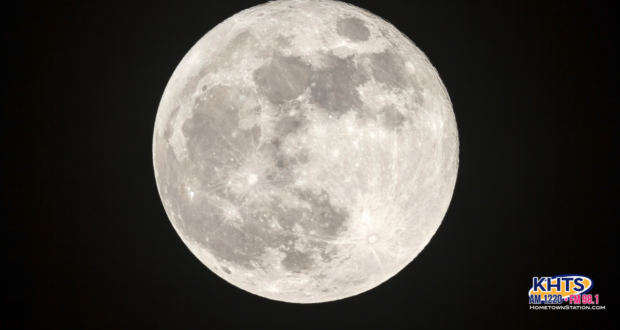
The third of four supermoons lit up the morning skies above Santa Clarita on Thursday.
The full moon reached peak illumination on Thursday morning, Oct. 17, 2024, at 7:26 am ET, according to the National Aeronautics and Space Administration (NASA).
October’s supermoon was the closest at 222,055 miles (357,364 kilometers) from Earth, according to NASA.
As the full Moon after the Harvest Moon, Thursday’s event is named the “Hunter’s Moon.”
The earliest written use of the term “Hunter’s Moon,” identified in the Oxford English Dictionary, is from 1710.
According to the Farmer’s Almanac, with the leaves falling and the deer fattened, it is time to hunt. Since the harvesters have reaped the fields, hunters can easily see the animals that have come out to glean (and the foxes that have come out to prey upon them).
The Maine Farmer’s Almanac first published Native American names for the full Moons in the 1930s. Over time, these names have become widely known and used.
The first appearance of the Supermoon Blue Moon took place Monday afternoon, August 19, 2024, at 2:26 PM EDT, according to the National Aeronautics and Space Administration (NASA).
A supermoon happens when a full moon occurs as the Moon is closest to Earth along its orbit. The proximity varies even for supermoon occurrences, with the strongest ones appearing about 14% larger than when a full moon is farthest from Earth, according to NASA.
Supermoons occur about three to four times a year. The term supermoon was coined by astrologer Richard Nolle in 1979 to describe either a new or full moon that occurs when the Moon is within 90% of its closest approach to Earth, said NASA.
A full blue moon occurs within a day or so of perigee, so it occurs three to four times a year. About 25 percent of all full moons are supermoons, but only 3 percent are blue moons.
Despite the name, blue moons are not literally blue. Instead, the name refers to when two full moons occur in a calendar month.
The time between super blue moons is quite irregular. It can be as much as 20 years but in general, 10 years is the average, according to NASA.
The last remaining supermoon is set to take place on Saturday, Nov.16
The best time to view the Supermoon is around 10 to 11 p.m. local time, which gives the moon some time to rise into the sky. From there, viewers should be able to view it all night.
The next time that the supermoon coincides with a seasonal blue moon will be Aug. 21, 2032, NASA said. The next supermoon that converges with a monthly blue moon will be in January 2037.
To learn more information about the full blue supermoon, visit NASA website.
Sponsored Articles
KHTS FM 98.1 and AM 1220 is Santa Clarita’s only local radio station. KHTS mixes in a combination of news, traffic, sports, and features along with your favorite adult contemporary hits. Santa Clarita news and features are delivered throughout the day over our airwaves, on our website and through a variety of social media platforms. Our KHTS national award-winning daily news briefs are now read daily by 34,000+ residents. A vibrant member of the Santa Clarita community, the KHTS broadcast signal reaches all of the Santa Clarita Valley and parts of the high desert communities located in the Antelope Valley. The station streams its talk shows over the web, reaching a potentially worldwide audience. Follow @KHTSRadio on Facebook, Twitter, and Instagram.