KHTS Radio Santa Clarita Radio – Santa Clarita News

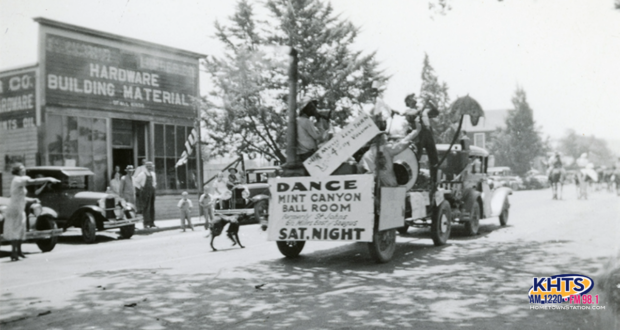
For nearly a century, the people of Santa Clarita have come together each Independence Day to celebrate not just the birth of a nation but the strength, resilience, and unity of their community.
The Fourth of July Parade, held annually in Newhall — with few interruptions — is more than just a festive display of patriotism; it’s a living history of a valley that has seen growth, adversity, and deep pride in its heritage.
Humble Beginnings and Early Celebrations
While there are no local newspapers from the earliest years of Newhall’s founding in the 1870s to document Independence Day celebrations, photographic evidence and oral histories suggest that the community likely celebrated the holiday in some form from the very beginning.
Early 20th-century gatherings were held in places like Saxonia Park in Placerita Canyon. Later, after a grammar school was built in Newhall in the 1920s, festivities moved to the adjacent park. Pie-eating contests, greased pole climbs, and pig-catching were staples of the day.

Newhall Fourth of July Celebration, Saxonia Park, 1909-1913. Courtesy of the Santa Clarita Historical Society.
As the Santa Clarita Valley’s small towns and scattered farms grew closer over time, the Fourth became a unifying occasion — a rare moment when residents set aside daily concerns to come together in celebration.
A Parade is Born – 1932
The modern tradition of the Newhall Fourth of July Parade began in 1932, during the heart of the Great Depression.
A.B. “Dad” Thatcher, who the year before had lamented the community’s apathetic observance of the Fourth, celebrated the turnaround in a column. The 1932 event was described as, “The greatest and most colorful festivity that has marked the public doings in town for many years.”
“The parade formed on Arch Street,” said Thatcher in his column, “from whence it marched to Newhall Avenue, which was followed to Tenth Street (now called Lyons Avenue), turning to Spruce Street (now called San Fernando Road*) and moving south to Market Street, where it turned to the playground near the Community Church and dissolved.”
Themed “Old Time,” it featured a mule team freight line, cowboys, ranchers, and newer icons of progress, like S.D. Dill’s brand-new 1932 school bus.
Community pride was on full display. Newhall Ice, still a local business today, took home a prize for originality, while the Catholic Ladies won Sweepstakes for their detailed float of the San Fernando Mission.
After the parade, roughly 2,000 people gathered for speeches, a barbecue, sporting events, and a fireworks display at Newhall School. This event marked the beginning of an enduring civic tradition.
A Tradition Interrupted and Reignited
From 1932 through 1936, the parade was held annually. But in 1937 and 1938, the tradition paused without significant protest, replaced by other holiday festivities such as church-sponsored picnics and community dinners.
With World War II looming, patriotism surged, and the parade returned in 1939, continuing through 1941. After the attack on Pearl Harbor in December 1941, wartime restrictions hit hard.
Fireworks were banned due to powder rationing, and no parades were held from 1942 to 1945. Still, the spirit of celebration endured. Spruce Street (Now Main Street) was lined with American flags, and in 1943, the community celebrated Bermite Powder Company receiving the Army-Navy “E” award with a large gathering at Bonelli Stadium (Saugus Speedway).
In 1944, Newhall residents enjoyed a unique retrospective when they watched footage of the 1939 parade, filmed by Monogram Studios, shown at the American Theater, today’s American Legion Post 507.
With the war’s end in 1945, the parade resumed in 1946 and has continued nearly uninterrupted since.
The Near-Miss of 1955
In 1955, the parade almost didn’t happen. The organizing group known as the “Old West” Association dissolved unexpectedly. But a small group of determined citizens — including A.B. Perkins, Fred Trueblood, and several others — refused to let the tradition die.

This is downtown Newhall’s entire 1955 Fourth of July Parade. Courtesy of the SCV Historical Society.
Just 14 people marched down Spruce Street that year in a makeshift “parade,” led by a young man with a sign that read, “Don’t Let the Tradition Die.”
This humble act of perseverance ensured the continuity of what has become one of the Santa Clarita Valley’s most cherished annual events.
Growing Through the Years
Over time, the Fourth of July Parade grew in scale and significance. By the 1990s, it had become a massive event, drawing thousands of spectators and hundreds of entries.
One particularly memorable year was 1994 when the parade took a temporary detour from its usual route down what was then the San Fernando Road (now Main Street) and instead proceeded down Walnut Street.
That year’s theme, “Earthquake Heroes,” honored first responders and everyday citizens who served heroically in the aftermath of the Northridge Earthquake that struck earlier that January. Carl Goldman, co-owner of KHTS Radio, served as Grand Marshal, accompanied by his wife, Jeri Seratti-Goldman and their son.

July 4, 1994 — Carl Goldman, grand marshal of the 1994 SCV Fourth of July Parade in downtown Newhall. Courtesy of the SCV Historical Society.
By this point, the Fourth of July Parade had become not just a local tradition but a reflection of the valley’s identity — resilient, proud, and community-driven.
A Post-Pandemic Return
Even a global pandemic couldn’t keep the spirit of the parade down for long. After a two-year hiatus due to COVID-19, the parade returned in 2022, bringing together elected officials like Senator Scott Wilk, Assemblywoman Suzette Valladares, and Olympian Brittany Cervantes, who rode aboard the KHTS fire truck.

Santa Clarita Fourth of July Parade returns.
The return of the parade marked a symbolic renewal for the Santa Clarita Valley after years of hardship and isolation.
More Than Just a Parade
While the parade is the crown jewel of Santa Clarita’s Independence Day, it’s far from the only celebration. Over the decades, festivities have included Frontier Days at the Soledad Canyon fairgrounds, pig races, greased pole contests, and fireworks displays. In the late 1930s, the African American community of Val Verde hosted picnics and baseball games as part of their own celebration of the holiday.
Whether through elaborate floats or simple flags on Main Street, Santa Clarita has found ways — year after year — to express its gratitude for the freedoms Americans share.
A Living Legacy
From the dusty roads of Depression-era Newhall to the sprawling, vibrant cityscape of Santa Clarita today, the Fourth of July Parade has remained a constant.
It’s a day when history marches forward, sometimes with a mule team, sometimes on a fire truck, and the whole community comes together, united by a shared past and a hopeful future.
To read yesterday’s Today in SCV History, click here
Sponsored Articles
KHTS FM 98.1 and AM 1220 is Santa Clarita’s only local radio station. KHTS mixes in a combination of news, traffic, sports, and features along with your favorite adult contemporary hits. Santa Clarita news and features are delivered throughout the day over our airwaves, on our website and through a variety of social media platforms. Our KHTS national award-winning daily news briefs are now read daily by 34,000+ residents. A vibrant member of the Santa Clarita community, the KHTS broadcast signal reaches all of the Santa Clarita Valley and parts of the high desert communities located in the Antelope Valley. The station streams its talk shows over the web, reaching a potentially worldwide audience. Follow @KHTSRadio on Facebook, Twitter, and Instagram.